
AIRLINE SEATING CHARTS - AIRCRAFT DIAGRAM SEATING ARRANGEMENTS AND LAYOUTS
AIRLINE CABIN SEATING MAPS AND CHARTS FOR JETBLUE, SOUTHWEST, DELTA, CONTINENTAL, ANA, FINNAIR, AIRTRAN, EASYJET, QANTAS, LUFTHANSA, HAWAIIAN, KOREAN, NORTHWEST, SINGAPORE, MALAYSIA, CHINA, AIR FRANCE, UNITED AND AMERICAN AIRLINES FOR THE AIRBUS A318, A319, A320, A330, A340, A350, A380, EMBRAER, BOEING 737, 747, 757, 767, 777 AND 787 AIRLINERS. 
THE BELOW LINKS CONTAIN DETAILED AIRLINE, MILITARY JETS, TEST AIRCRAFT, AIRPLANE FACT SHEETS AND AEROSPACE INFORMATION  THE BELOW LINKS CONTAIN AVIATION, MILITARY, AIRCRAFT VIDEOS, PICTURES, FACTS, INFORMATION, AUDIO, HISTORY, MOVIES AND PHOTOS  THE BELOW LINKS CONTAIN FLIGHT TRACKING, AIRPORT INFO, AVIATION PIONEERS, USAF REFERENCES, NTSB FACTS AND AVIATION WEATHER THE BELOW LINKS CONTAIN INFORMATION ON AIRLINES IN CURRENT SERVICE TODAY AND ALSO BANKRUPT US AIRLINE COMPANIES (DEFUNCT)
|



AIRLINE SEATING CHARTS
AIRCRAFT SEATING ARRANGEMENTS FOR AIRLINERS
AIRPLANE SEAT MAPS FOR AIRBUS EMBRAER & BOEING JETS
 |
 |
 |

Below you will find UPDATED Airline Cabin Seating Maps and Charts for JetBlue, Southwest, Delta, Continental, ANA, easyjet,
Qantas, Lufthansa, Northwest, Singapore, FinnAir, Korean, Hawaiian, AirTran, Air France, United, Malaysia, China and American Airlines.
Seating Charts for the Airbus A319, A320, A330, A340, A380, Embraer, Boeing 737, 747, 757, 767, 777 and 787 Airliners.
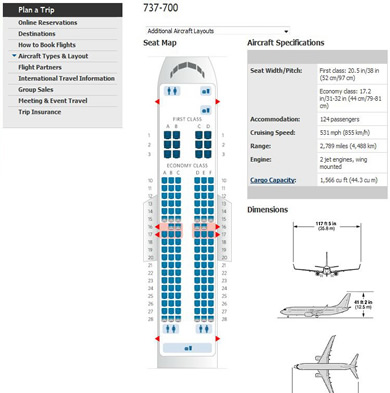
 BOEING 737-700 SOUTHWEST AIRLINES SEATING CHART 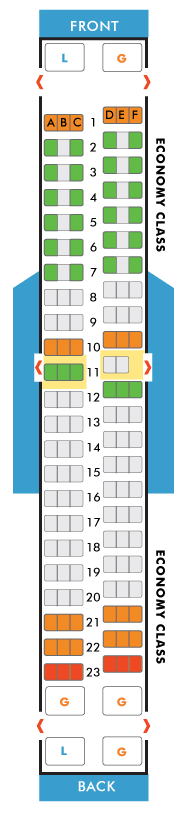 |
 AIRBUS A319 SPIRIT AIRLINES SEATING CHART 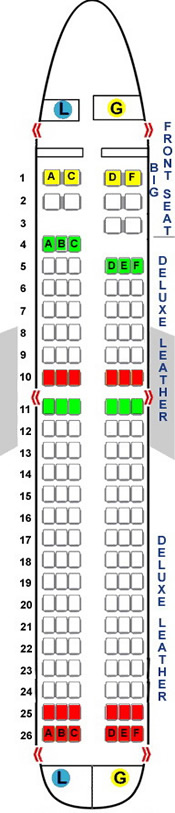 |
|
 AIRBUS A330 NORTHWEST AIRLINES SEATING CHART 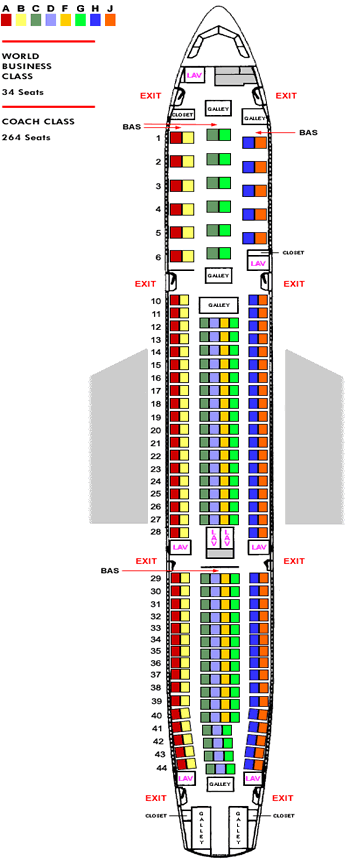 |
AIRBUS A330-300 CHINA AIRLINES SEATING CHART  |
MALAYSIA AIRLINES BOEING 777 SEATING CHART  |
BOEING 737-900 CONTINENTAL AIRLINES SEATING CHART  |
BOEING 737-800 DELTA AIRLINES SEATING CHART 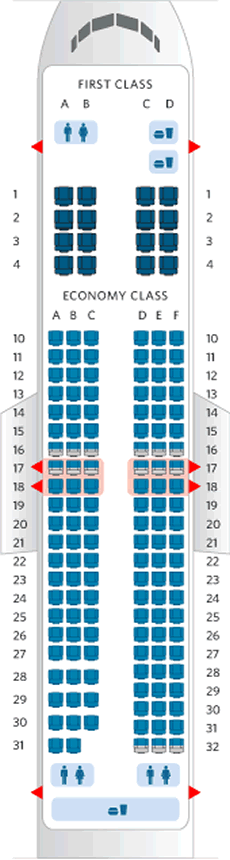 |
BOEING 767-300 DELTA AIRLINES SEATING CHART 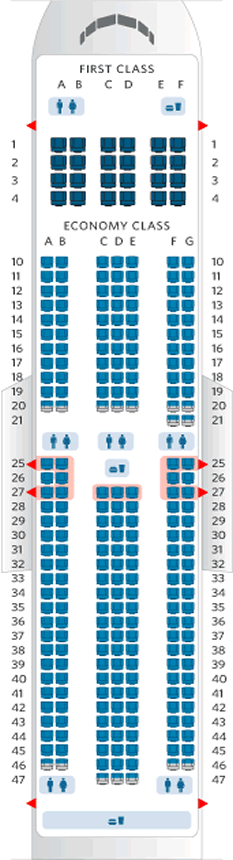 |
BOEING 777 DELTA AIRLINES SEATING CHART 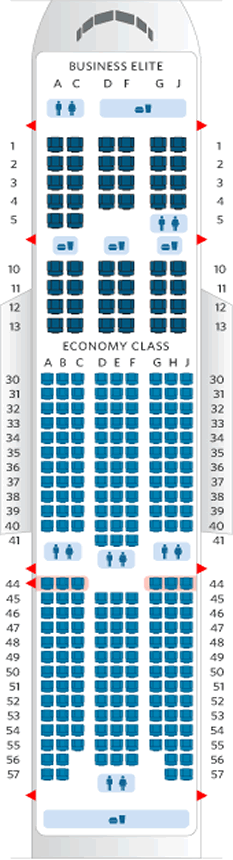 |
BOEING 757-300 NORTHWEST AIRLINES SEATING CHART 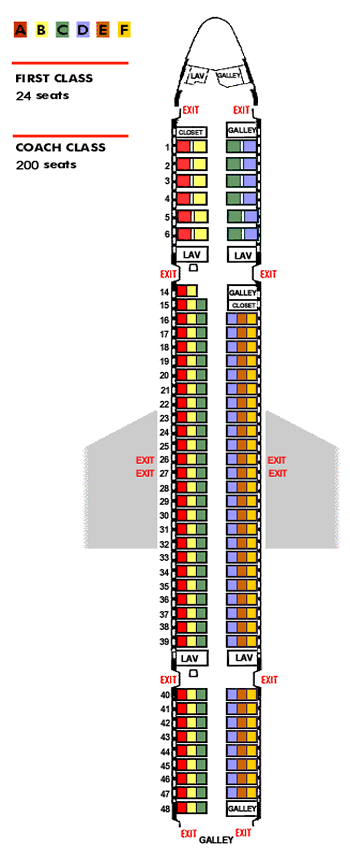 |
BOEING 777 CONTINENTAL AIRLINES SEATING CHART 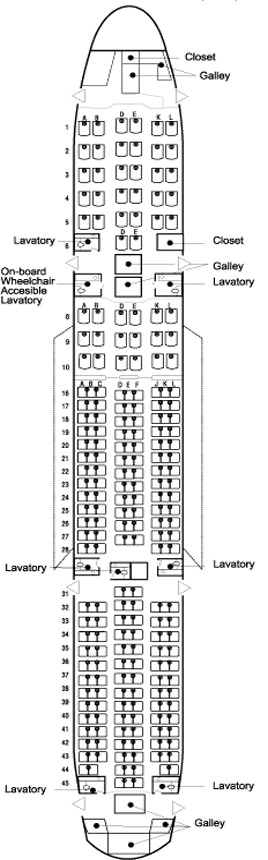 |
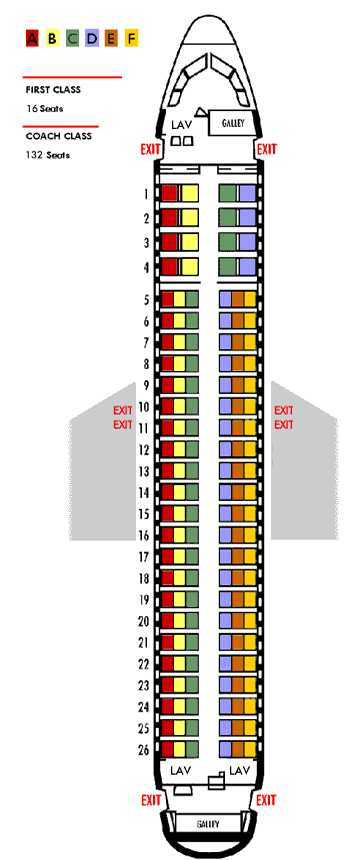
HOW TO GET THE BEST AIRLINE SEAT AT THE TIME OF YOUR TRAVEL BOOKING...
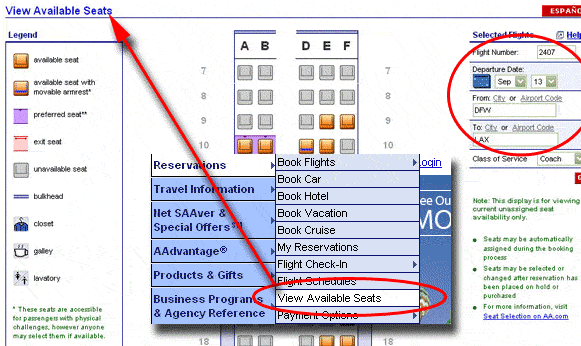
To get a preferred seat on a plane, it is extremely important to select your seat as early as possible. Most booking engines and airlines allow you to select your seat at time of purchase. Select the best available seat by comparing the airline or booking engine seat map. Even if your first choice seat is not available, select another option to ensure you have a seat assignment; it can usually be changed later. |
BOEING 787 AIRLINE SEATING CHART - ANA (ALL NIPPON AIRWAYS) The ANA Boeing 787-8 has a total of 158 seats, 46 flat-bed reclining Business Class seats, and 112 Economy class seats with a seat pitch of 33-34 inches. 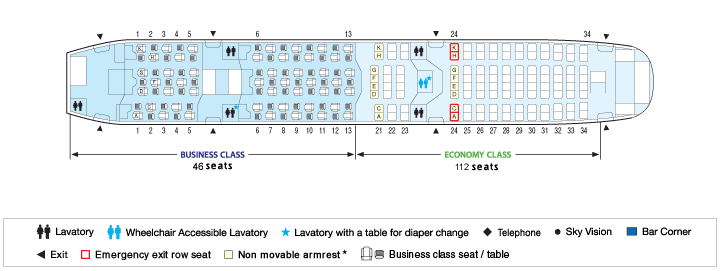 |
|

EASYJET AIRLINES AIRBUS A320 AIRCRAFT SEATING CHART 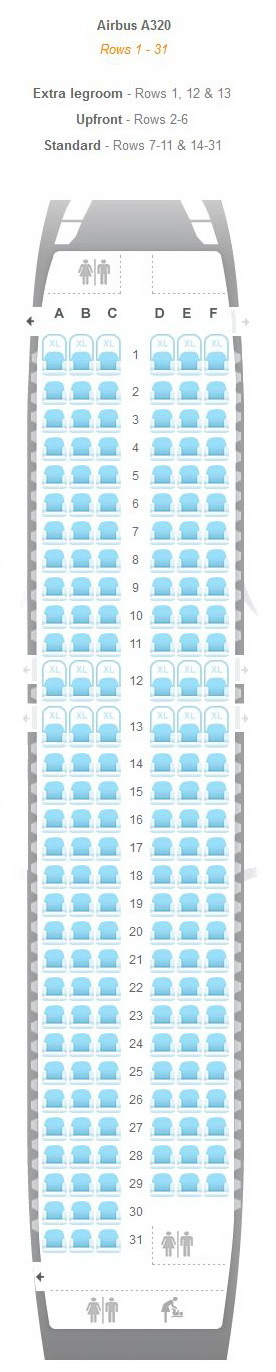 |
QANTAS AIRLINES BOEING 737-800 AIRCRAFT SEATING CHART 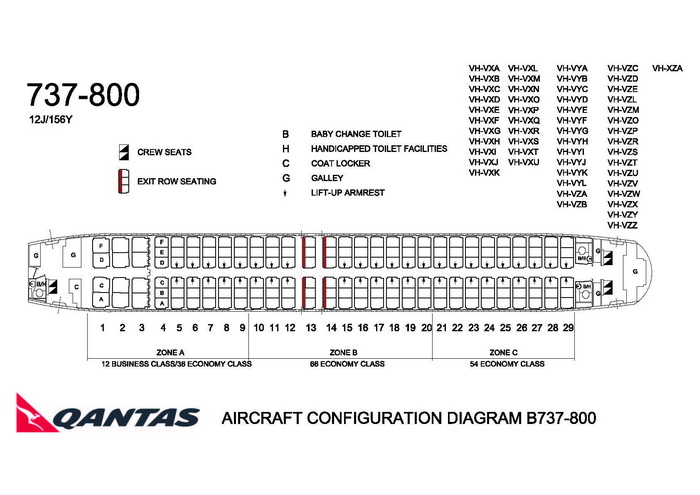 |
OTHER WAYS TO GET THE BEST AIRLINE SEAT ON AIRLINES AND AIRLINERS...
Making the best of economy class.... Fly JetBlue: This is easy. JetBlue has added extra legroom on its Airbus jets, with at least a 36-inch seat pitch in the first 11 rows of its Airbus 320 fleet and at least 34 inches in rows 12-25 (seat pitch is the distance between any one point on the seat and that same point in the row ahead or behind). Some airlines have 32 or even 31 inches between seats. Pay for exit rows: wSome people think it's obnoxious to charge for what was once free, but this perk is well worth it. Northwest and AirTran will sell you an exit row seat, with more leg room than in first class, for $15-20. Frequent flyers on Northwest get to reserve these seats when booking, for free if they're "elite" members. Mere mortals can book them within 24 hours of flight time. American Airlines also sells other "premium" seating for $5 to $25 per leg within the 48 states (the fee may be higher for Hawaii, Alaska, and international routes). Premium economy: When passengers are checking in, United Airlines sometimes offers them upgrades to "Economy Plus," which has up to 5 inches more leg room, for relatively little money. If you're a frequent United customer, check out Economy Plus Access, which allows you to reserve economy plus for yourself and a guest for a full year of travel. The basic plan costs $349 per year. |
|
BOEING 757 DELTA AIRLINES SEATING CHART 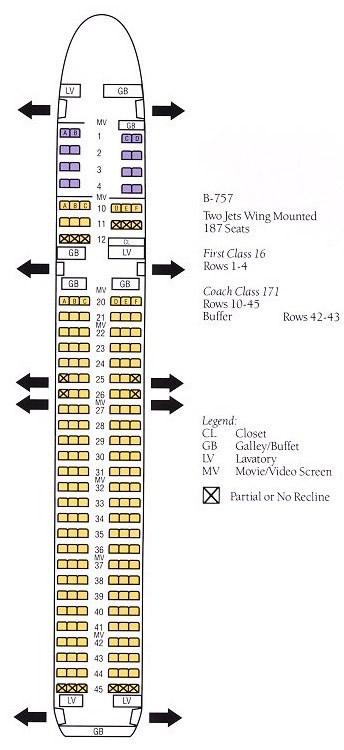 |
BOEING 777-300 KOREAN AIRLINES SEATING CHART 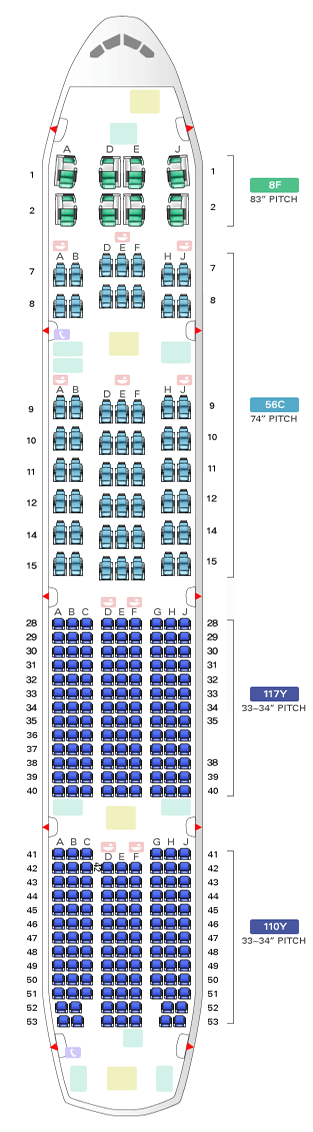 |
AIRBUS A330 HAWAIIAN AIRLINES SEATING CHART 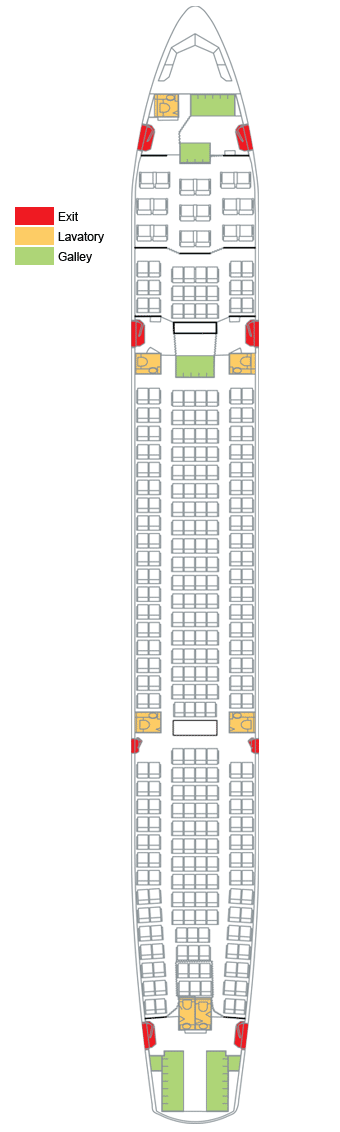 |
BOEING 717 AirTran AIRLINES SEATING CHART 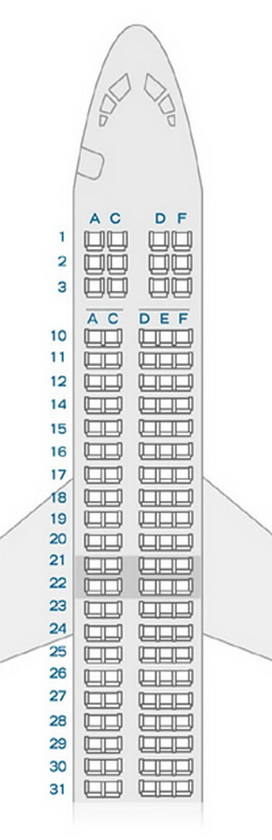 |
EMBRAER 170 FINNAIR AIRLINES SEATING CHART  |

Airline and Commercial Aircraft Seating Charts and Layouts Many people that fly for pleasure or for business purposes have to sit in an airplane for 2-3 hours or sometimes even longer, depending on the trip that they make, and during the flight, seating in an uncomfortable area or section in the airplane can be uncomfortable. This happens very often due the lack of details that each airline is publishing about their airplanes or because people that fly don’t consult an aircraft seat map before they book a ticket.
Airplane and airline seat charts can be really handy for frequent fliers and help them to choose their seat in the airplane even before they buy their tickets. Knowing the place where you sit before going aboard allows you to find out details of a specific seat from extra legroom to missing windows or any other details. Seat maps published by airlines Most of the airlines publish seat configurations for their airplanes but the quality of those seat maps is some times questionable and some of the details and information about seats are very general. Usually airlines don’t publish seat maps for all of their airplanes, they do it only for the major airplanes and for the ones flying on frequent routes. Seat maps published by specialized websites In addition to published seat maps which can be found on airlines websites, there are some other sites that publish aircraft seat maps for almost all the commercial airplanes that are flying these days. Seat maps that can be found on these specialized sites have the airline seating maps have more detailed seat information. Reading and understanding a seat map should be carefully looked at because of the design of each seat map. Reading the legend will help understand the seat arrangements and the meaning of each symbol from the seat map. Passengers can then make the best decision for their flight and seating choice. Airplane seat maps that can be found on the online can help people choose the best seat that will make for a more comfortable flight. Finding the right seat with the help of an aircraft seat map can improve your experience and make your short or long haul flight much more enjoyable. |
|
MD-88 DELTA AIRLINES SEATING CHART 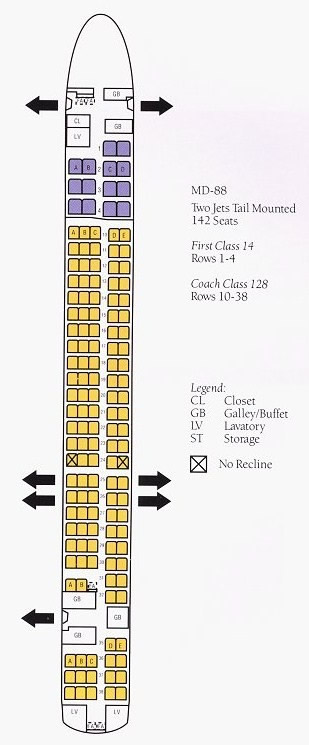 |
BOEING 747-400 NORTHWEST AIRLINES SEATING CHART 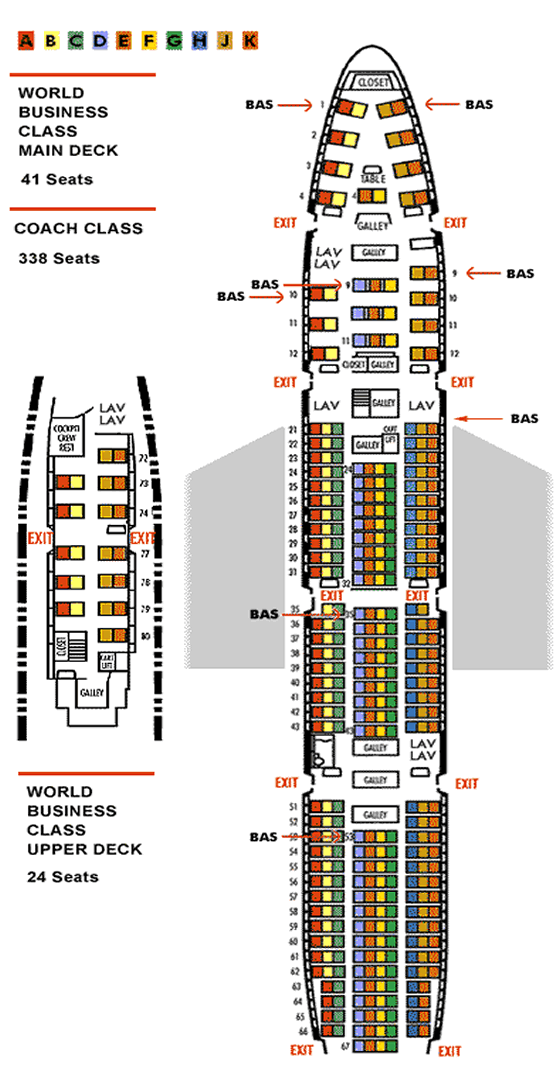 |
AIRLINE SEATING - AIRCRAFT CONFIGURATIONS - AIRCRAFT CABIN LAYOUT - AIRLINE AIRCRAFT SEATING CHARTS
Airline cabins are frequently classified as narrow-body if there is a single aisle with seats on either side, or wide-body if there are two aisles with a block of seats between them in addition to the seats on the side. The number of seats abreast is affected by the aircraft width. On very small aircraft such as the Beechcraft 1900 there are only individual seats on each side of the aisle (1+1 seating). The widest narrow body aircraft such as the Airbus A320 and Boeing 737 have six abreast seating in a 3+3 layout. Asymmetrical layouts also exist, the Embraer Regional Jets have 1+2 seating while the Douglas DC-9 aircraft typically feature 2+3 seating. On wide body-aircraft the center block of seats between the aisles can have as many as 5 seats on planes like the layout on some McDonnell Douglas DC-10 and Boeing 777 aircraft, although Boeing recommends the 3+3+3 over the 2+5+2 layout. Very wide planes such as the Boeing 747 or the Airbus A380 have ten seats abreast, typically in a 3+4+3 layout, although this layout is also sometimes used as a high density layout on aircraft normally seating nine abreast, such as the 787 or L-1011. On most commercial aircraft, seats are forward facing. There are exceptions. On military aircraft seats are frequently rearward facing. Southwest Airlines previously offered a few such seats on some aircraft, rearward facing seats are also common on business jets to provide a "conference" type layout. British Airways also has rearward-facing seats in its Club World (Intercontinental Business Class) Cabin. It has been argued that rearward facing seats are safer because in the event of a crash, the sudden deceleration will propel the passenger into a rearward facing seat instead of out of it. The force is therefore distributed over the entire seat back, instead of the straps of the seat belt. The argument against such seats has been based on passenger comfort, safety and cost. An argument against rearward seats has been that passengers who desire the natural layout of forward facing seats may be uncomfortable with a rearward layout. On the safety aspect, the argument has been that during a plane crash, debris such as luggage, will fly forward in the cabin, quite possibly into the passengers in rearward facing seats. On the cost aspect, rearward facing seats need additional strengthening which adds extra weight and therefore higher costs. |
THE BELOW SEATING CHARTS ARE FOR BOEING AIRLINERS NON SPECIFIC TO ANY AIRLINE BUT GENERAL BOEING AIRCRAFT SEATING ARRANGEMENTS |
BOEING 727 FAMILY OF AIRCRAFT AIRLINE SEATING CHARTS 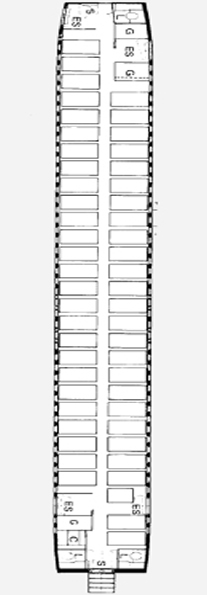 |
BOEING 737 FAMILY OF AIRCRAFT AIRLINE SEATING CHARTS 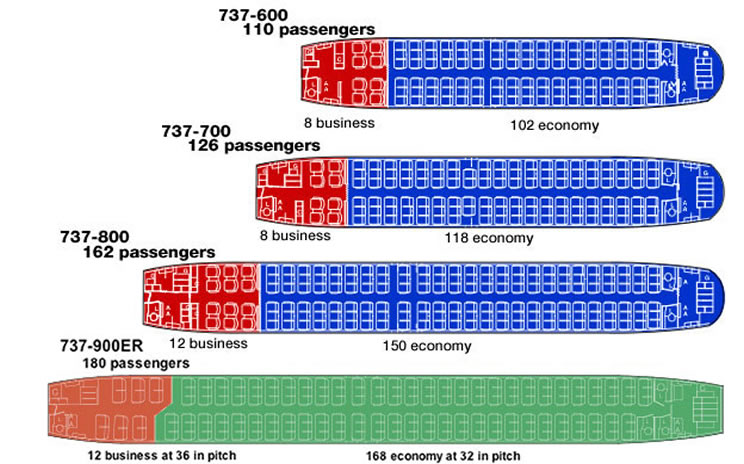 |
BOEING 747-400ER AIRLINE SEATING CHART 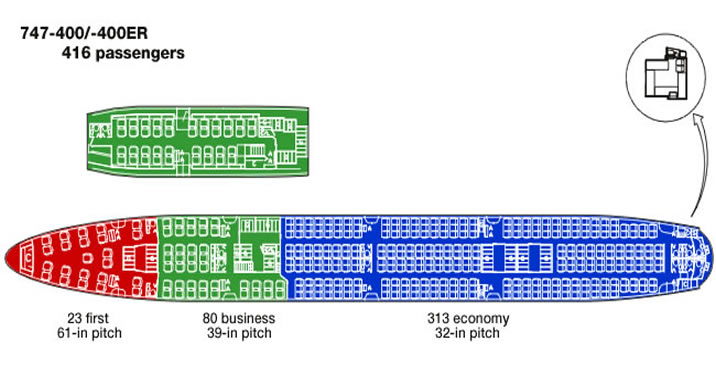 |
BOEING 757 FAMILY OF AIRCRAFT AIRLINE SEATING CHARTS 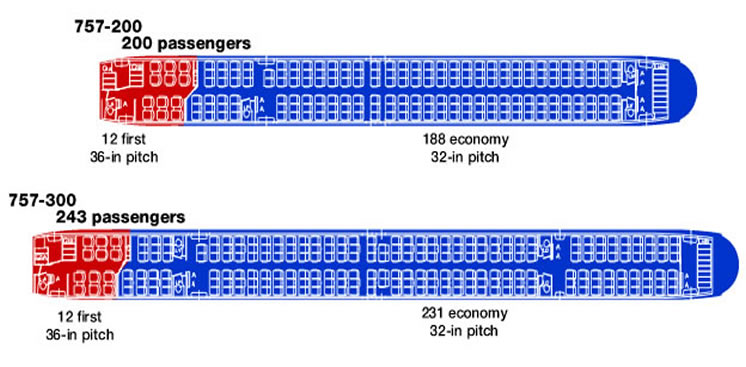 |
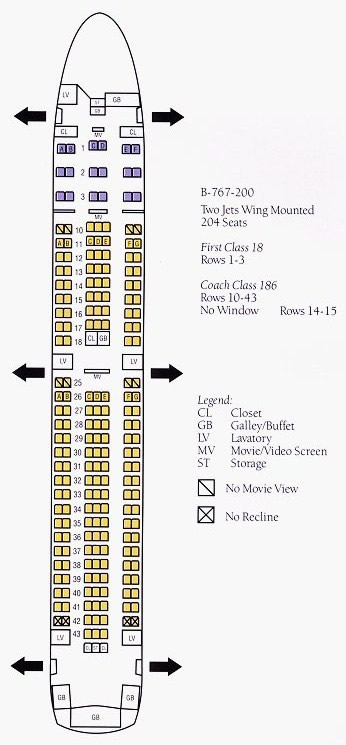
BOEING 767 FAMILY OF AIRCRAFT AIRLINE SEATING CHARTS 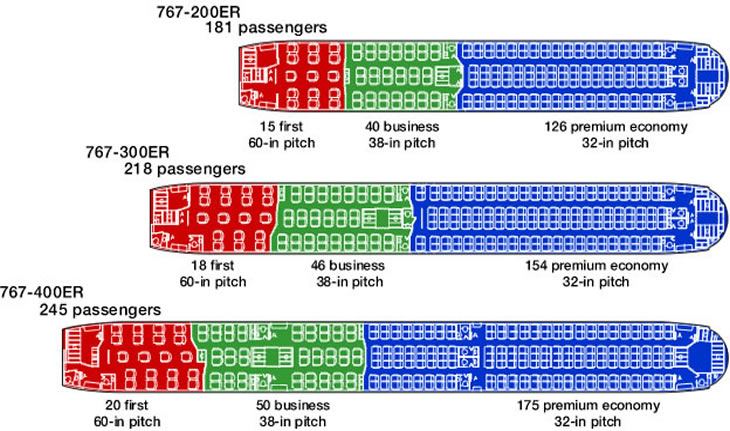 |
AIR FRANCE BOEING 777 AIRCRAFT AIRLINE SEATING CHARTS 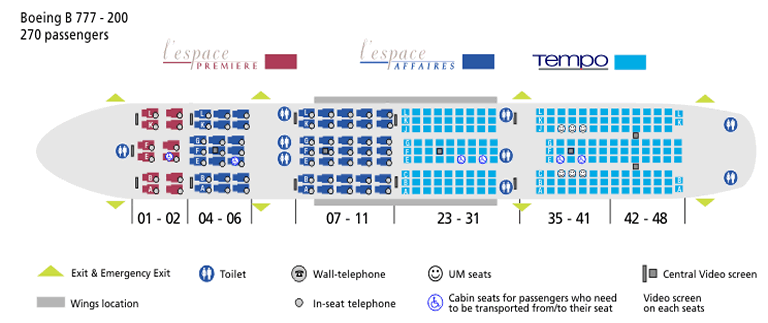 |
BOEING 777 FAMILY OF AIRCRAFT AIRLINE SEATING CHARTS 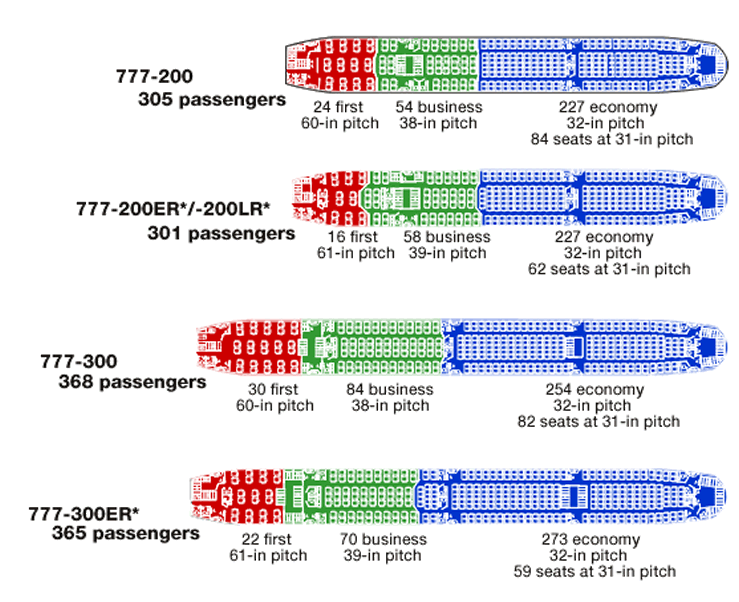
|
THE AIRBUS A380 DOUBLE DECKER SINGAPORE AIRLINES SEATING CHART 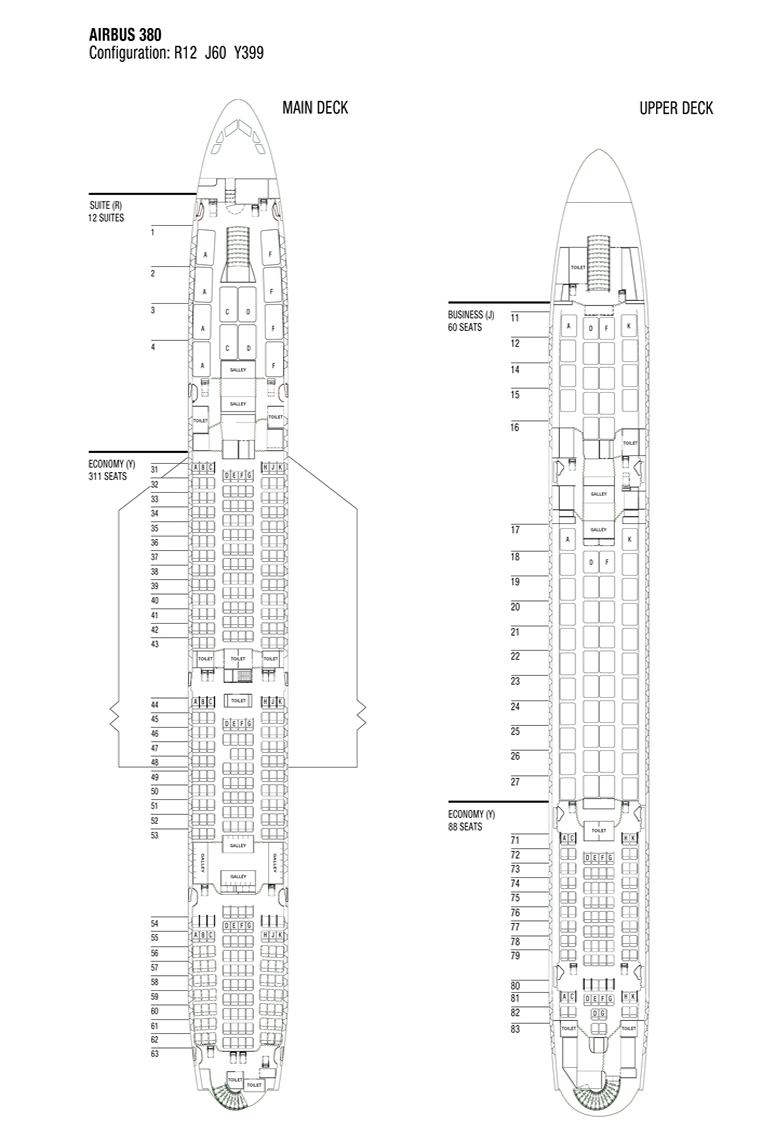 |
CRJ200 AIRLINE SEATING CHART 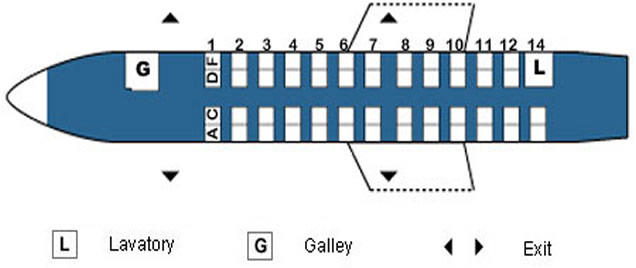 |
AIRBUS A330-300 AIRLINE SEATING CHART 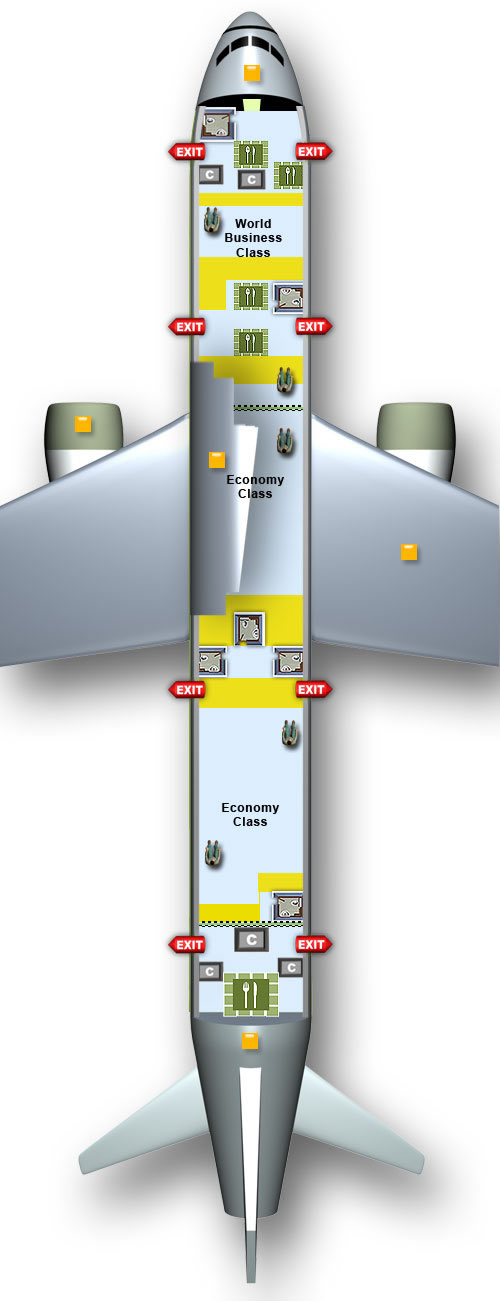 |
LUFTHANSA AIRBUS A380-800 AIRLINE SEATING CHART - UPPER AND LOWER DECK SEATING ARRANGEMENTS 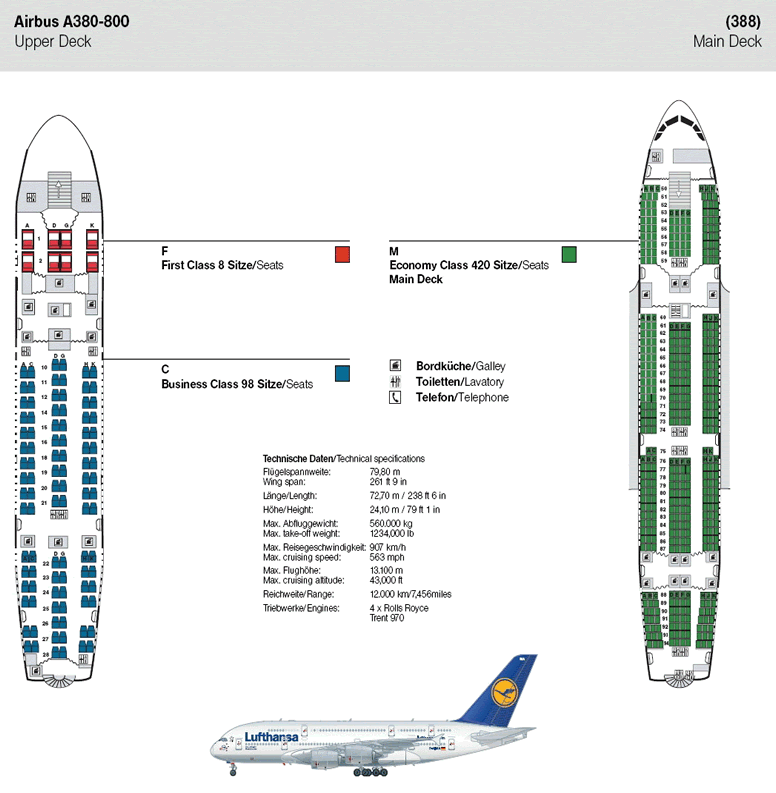
|
 |
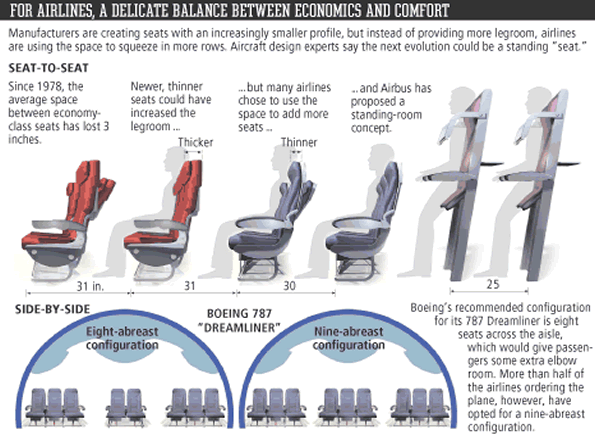
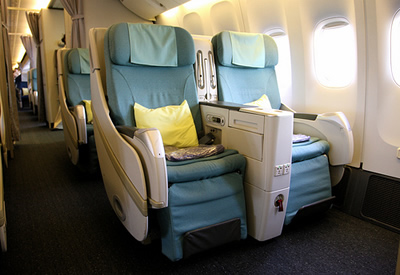
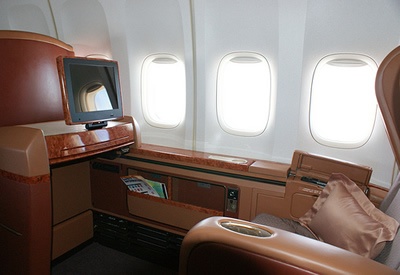
AIRCRAFT SEAT MAPS AND AIRLINE SEATING CHARTS An aircraft seat map or seating chart, is a diagram of the seat layout inside a passenger aircraft. They are often published by the airliners for informational purposes, and are of use to passengers who can select their seat at booking or check-in. Seat maps usually indicate the basic seating layout, the numbering and lettering of the seats, the location of the emergency exits, lavatories, galleys, bulkheads and wings. Airlines which allow internet check-in frequently present a seat map indicating free and occupied seats to the passenger so that they select their seat from it. In addition to the published seat maps from airliners, there are a number of independent websites which also publish seat maps along with reviews of individual seats, noting the particularly good (extra legroom, quiet cabin, etc.) or bad (lack of recline, unusually cramped, missing window, etc.) seats. Most of the airlines publish the seat configurations for their aircraft, but the quality of these seat maps is sometimes questionable. Some of the details and information about seats are confusing. Usually airlines do not publish seat maps for every aircraft, only for the larger aircraft and for the ones flying on frequent routes. In addition to those published seat maps which can be found on airline websites, there are some other sites that publish aircraft seat maps for almost all commercial aircraft. Seat maps that can be found on these sites usually have more details and on some websites you can find comments from other passengers with ups and downs about each particular airplane seat. On many aircraft, the rightmost seats have letter designations HJK, skipping the letter I. This is because each seat has a row number followed by letter. Letters that confuse with numbers must be avoided. Digital Equipment Corporation (DEC) was the first to implement this, avoiding I (1), O (0) and S (5). The remaining letters are called the DEC alphabet. A wide-body aircraft is a large airliner with two passenger aisles, also known as a twin-aisle aircraft. The typical fuselage diameter is 5 to 6 m (16 to 20 ft). In the typical widebody economy cabin, passengers are seated seven to ten abreast, allowing a total capacity of 200 to 600 passengers. The largest widebody aircraft are over 6 m (20 ft) wide, and can accommodate up to eleven passengers abreast in high-density configurations. Wide-body aircraft are also used for the transport of commercial freight and cargo and other special uses, described further below. For comparison, a traditional narrow-body airliner has a diameter of 3 to 4 m (10 to 13 ft), with a single aisle and seats between two and six people abreast. Widebody aircraft were originally designed for a combination of efficiency and passenger comfort. However, airlines quickly gave in to economic factors, and reduced the extra passenger space in order to maximize revenue and profits. Depending on how the airline configures the aircraft, the size and seat pitch of the airline seats will vary significantly. For example, aircraft scheduled for shorter flights are often configured at a higher seat density than long-haul aircraft. Due to current economic pressures on the airline industry, high airline seating densities in the economy cabin are likely to continue. On the oldest of planes, seats were armchairs which stood loosely in the cabin, but moving furniture in the aircraft is a safety hazard, and seats are now fastened to the floor. However, airlines usually want the flexibility to move seats around or remove them, so the seats are attached to rails underneath the floor which run along the aircraft fuselage. If the airline wants to reconfigure the seating, this is a minor operation. For passenger safety, airline seats are equipped with seatbelts, and there is a "Fasten Seatbelts" sign above each seat which is lit up when passengers are expected to remain seated with the seatbelt fastened. This is during taxiing, take-off and landing, although turbulence may also prompt the captain to turn on this sign. Seats are frequently equipped with further amenities. Airline seats may be equipped with a reclining mechanism for increased passenger comfort, either reclining mechanically (usually in economy class and short-haul first and business class) or electrically (usually in long-haul first class and business class). Most aircraft also feature trays for eating and reading, either in the seatback which folds down to form a small table in most economy class seats, or inside the armrest which folds out in most first class, business class, bulkhead, and exit row seats. Most airline seats also feature a pocket which may contain an in-flight magazine and a "safety on board" manual. On small and short-haul aircraft, or on low-cost carriers, some of these amenities may not be installed. For instance, on several aircraft Ryanair has installed non-reclining seats without seat pockets with the safety manuals stitched to the seat back instead. Even on airliners with reclining seats, some seats may have a restricted recline or no recline. Typically this will be the rear row of the cabin where a rear bulkhead blocks the recline, or seats immediately in front of the emergency exit where a reclined seat might restrict access to the emergency exit, creating a potential safety hazard. Independent seat review sites such as SeatGuru often warn passengers against these seats. During take-off and landing the crew ask passengers to put their seats in an "upright" (unreclined) position and to lift and stow their tray tables. Seats may be equipped with power ports (either EmPower, AC, or DC) for small electrical appliances and ports for headphones for the audio entertainment. Some airlines also place TV-screens in the back of each seat as part of the In-flight Entertainment system on long-haul aircraft. Most long-haul aircraft (and short-haul aircraft on some airlines) feature seats with adjustable headrests in all classes, allowing the passenger to adjust the headrest for comfort. Electrically adjustable lumbar support is found on most long-haul first class and business class seats. Rarely, economy class may also include a mechanically adjustable lumbar support on some long-haul aircraft, however, with the trend towards slimline seats in Economy class, this amenity has mostly vanished from most new Economy class seat installations. Examples of such aircraft with adjustable lumbar support in Economy class include Delta Air Lines Boeing 777-200ERs and US Airways A330-300s. Some business class seats, such as the Recaro CL 4420, have a built-in massaging feature. Some business class cabins feature seats that recline to a sloped flat position. These "lie flat at an angle" seats allow for greater comfort than traditional recliner seats, but are less comfortable than fully horizontal flat bed seating. Most international first-class and a growing number of international business-class cabins feature seats which recline to a full-horizontal flat position, forming a bed. Airline cabins are frequently classified as narrow-body if there is a single aisle with seats on either side, or wide-body if there are two aisles with a block of seats between them in addition to the seats on the side. The number of seats abreast is affected by the aircraft width. On very small aircraft such as the Beechcraft 1900 there are only individual seats on each side of the aisle (1+1 seating). The widest narrow body aircraft such as the Airbus A320 and Boeing 737 have six abreast seating in a 3+3 layout. Asymmetrical layouts also exist, the Embraer Regional Jets have 1+2 seating while the Douglas DC-9 aircraft typically feature 2+3 seating. On wide body-aircraft the center block of seats between the aisles can have as many as 5 seats on planes like the layout on some McDonnell Douglas DC-10 and Boeing 777 aircraft, although Boeing recommends the 3+3+3 over the 2+5+2 layout. Very wide planes such as the Boeing 747 or the Airbus A380 have ten seats abreast, typically in a 3+4+3 layout, although this layout is also sometimes used as a high density layout on aircraft normally seating nine abreast, such as the 777 or DC-10. Window seats are located at the sides of the aircraft, and usually next to a window, although some aircraft have seat rows where there is a window missing. Window seats are preferred by passengers who want to have a view, or a wall which they can lean against. Passengers in seats adjacent to the aisle have the advantage of being able to leave the seat without having to clamber over the other passengers, and having an aisle they can stretch their legs into. If a seat block has three or more seats, there will also be middle seats which are unpopular because the passenger is sandwiched between two other passengers without advantages of either window or aisle seats. Middle seats are typically booked last. On most commercial aircraft, seats are forward facing. There are exceptions. On military aircraft seats are frequently rearward facing. Southwest Airlines previously offered a few such seats on some aircraft, rearward facing seats are also common on business jets to provide a "conference" type layout. British Airways also has rearward-facing seats in its Club World (Intercontinental Business Class) Cabin. It has been argued that rearward facing seats are safer because in the event of a crash, the sudden deceleration will propel the passenger into a rearward facing seat instead of out of it. The force is therefore distributed over the entire seat back, instead of the straps of the seat belt. The argument against such seats has been based on passenger comfort, safety and cost. An argument against rearward seats has been that passengers who desire the natural layout of forward facing seats may be uncomfortable with a rearward layout. On the safety aspect, the argument has been that during a plane crash, debris such as luggage, will fly forward in the cabin, quite possibly into the passengers in rearward facing seats. On the cost aspect, rearward facing seats need additional strengthening which adds extra weight and therefore higher costs. Many airlines provide maps of their seating configurations on the various aircraft they fly. SeatExpert.com and SeatGuru.com also show seat maps for a wide range of airlines and aircraft, along with descriptions of the best and worst seats on the aircraft. When evaluating the size (and comfort) of a seat, the main terms used are pitch and width. It is a common misunderstanding that "pitch" is the same as "legroom". Seat pitch is an indication of legroom, referring to the space between a point on one seat and the same point on the seat in front of it. It is usually given in inches. For many carriers, the pitch in Economy class is 30 to 32 inches (76 to 81 cm). More seat pitch can mean more legroom, but it is also affected by the thickness of the seat back. Airlines have claimed that a reduction of seat pitch can be compensated for by a thinner seat-back design. The largest seat pitch in any commercial airline's short-haul economy section is 37 inches (94 cm) in Finnair's Airbus A319s. American Airlines' business class seats in their Boeing 767-200s are 62 inches (160 cm), the largest in any short-haul business class. US Airways' first class flatbed seats in their Airbus A330-300s have a seat pitch of 94 inches (240 cm). The seat pitch on low cost carriers can be 29 inches (74 cm) or 30 inches (76 cm). On Spirit Air it is 28 inches (71 cm) Seat width is the distance from armrest to armrest, in Economy class this is typically around 43 centimeters (17 in). |
 |
 |
 |
 |
 |
 |
 |
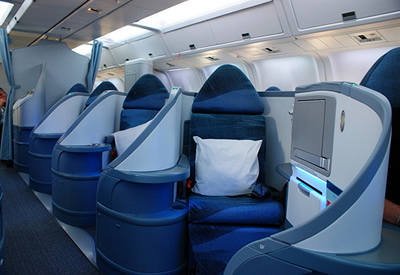 |
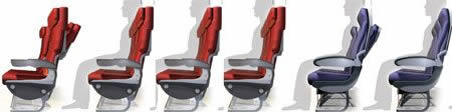
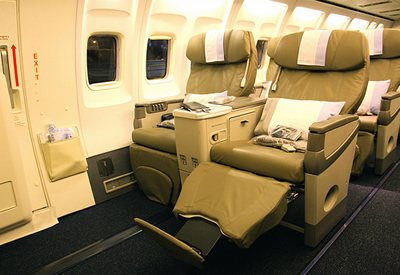
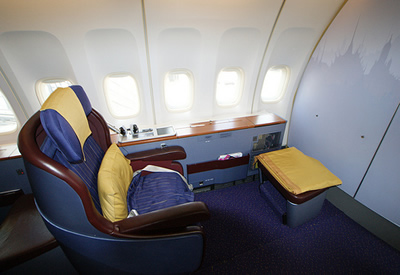
NEW AIRLINE SEATING ON LUFTHANSA AIRLINES BUSINESS CLASS JETS |
Question - I am taking a trip and I will be flying for my first time. I would like to know how do i find out what type of airplane or aircraft I will be flying on? Also where do I find out my airline seating position will be on the plane? I want a good window seat! Is there somewhere online I can go to find out if my airline seat is next to the bathroom or to close to the engines and super noisy or way in the back? How do I choose my airline seat so I can sit closer to the front of the plane?
Can I pick my airline seat position if I go to my airlines website? Do most airlines let you pick your airplane seat when you go to the airlines website? Do I have to pay extra for a better seat? Any help please? I really dont know what to expect? Answer - Get onto the airline's website and there will be a place usually where they will tell you that information. Look around the airlines "airplane" pages to find out about airplane type. There should also be an "Airline Seating Chart" to find your seat. You can also go to some of the popular websites that specialize in airline aircraft types (example here) and find where your airplane seat is located like SeatGuru or SeatExpert. Most airlines have many types of airplanes in their fleet and the specialty "airplane seats" websites will show you exactly where your seat is located.
You can also call your airlines 800 number and ask them to tell you where your seat is located on the plane. Some airlines will let you change your seating position over the phone and some will tell you to arrive at the airport early and you will get a boarding pass that relates to how many people have checked in before you. If you arrive at the airport early you can usually ask the person at the ticket counter about you seat or to see if the agent can give you the seating position you desire.
|
© AviationExplorer.com - The Website For Aviation Enthusiasts |