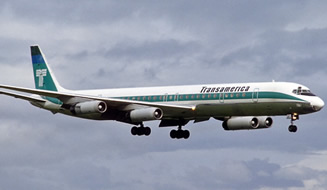
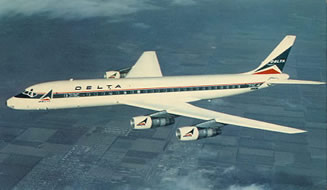
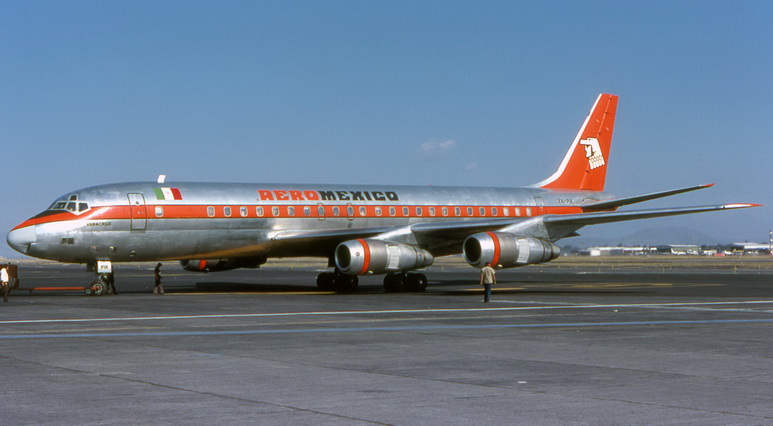
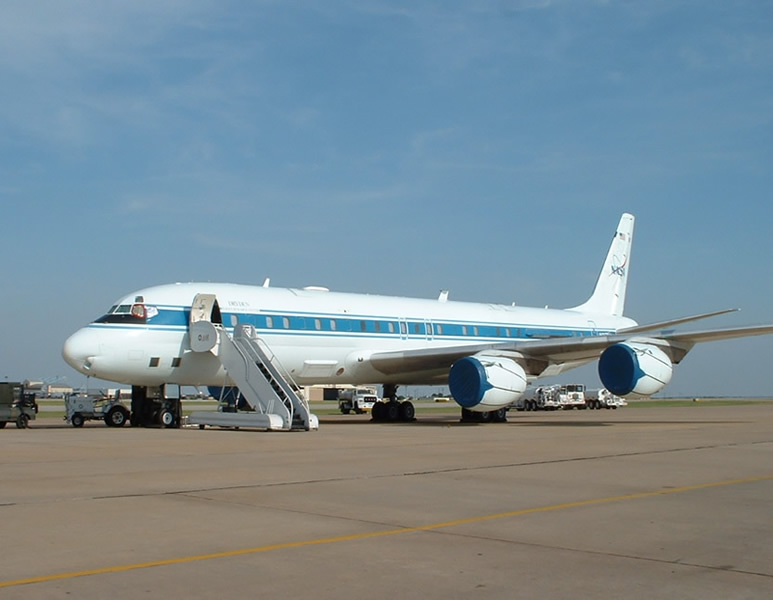
The Douglas DC-8 is a four-engined jet airliner,
manufactured from 1958 to 1972.
Background
When the world's first jet airliner, the De Havilland Comet, was introduced in 1949, Douglas held a commanding position in the aircraft market. Although Boeing had pointed the way to the modern all-metal airliner in 1933 with the 247, it was Douglas that, more than any other company, made the promise a reality. Douglas produced a succession of piston-engined commercial aircraft through the 1930s, 1940s and 1950s: 138 DC-2s, 10,928 DC-3s (mostly for military service in World War II), 1453 DC-4s, 537 DC-6s and 226 DC-7s.
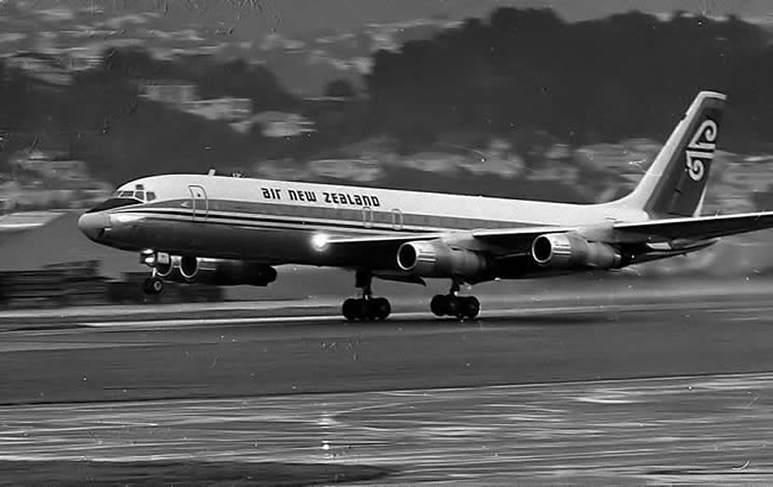
Given the success of their designs, Douglas took the view that there was no reason to rush into anything new, as did their rivals Lockheed and Convair. Most air transport manufacturers expected that there would be a gradual switch, from piston engines to turbines and that it would be to the more fuel-efficient turboprop engines rather than pure jets.
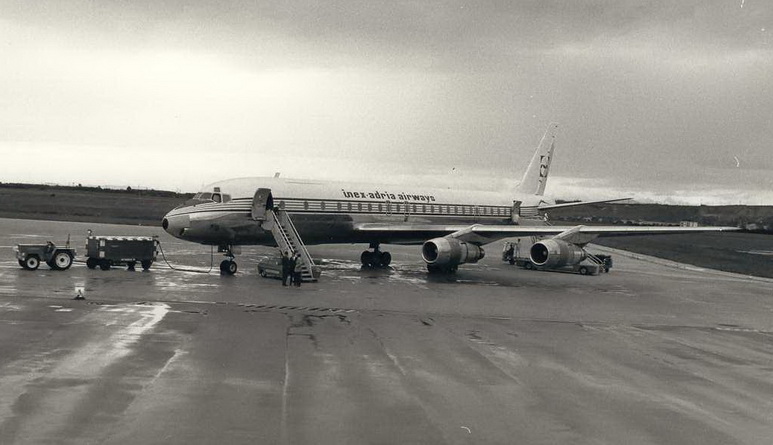
In contrast, Boeing took the bold step of starting to plan a pure jet airliner as early as 1949. Boeing's military arm had gained extensive experience with large, long-range jets through the B-47 Stratojet (first flight 1947) and the B-52 Stratofortress (1952). With thousands of their big jet bombers on order or in service, Boeing had developed a close relationship with the U.S. Air Force Strategic Air Command (SAC), and could count on having preference when the time came to replace SAC's fleet of piston-engined KC-97 Stratotankers.
For Boeing, this was a golden opportunity: an aircraft built to provide air-to-air refueling capacity for strategic bombers could be turned into a commercial transport with very little extra effort. Boeing could now plan on building a commercial jetliner — which might or might not sell — but either way the Air Force would pay for most of the development cost.
De Havilland's pioneering Comet entered airline service in 1952. Initially it was a success, but a series of fatal crashes in 1953 and 1954 resulted in the type being grounded until the cause could be discovered. Airlines cancelled orders for it, public confidence in the idea of jet transport plummeted, and it would take de Havilland four years to find and fix the problem. The cause of the Comet crashes was nothing to do with jet engines: it was rapid metal fatigue failure brought on by the stress of cycling a pressurized cabin to high altitudes and back. A new understanding of metal fatigue that the Comet investigation produced would play a vital part in the good safety record of later types like the DC-8.
Development
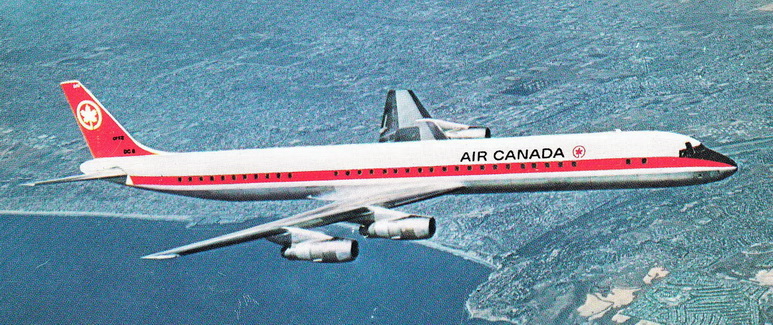
Air Canada DC-8 at Montréal-Dorval International AirportIn 1952, Douglas remained the most successful of the commercial aircraft manufacturers. They had almost 300 orders on hand for the piston-engined DC-6 and its successor, the DC-7, which had yet to fly and was still two years away from commercial service. The Comet disasters, and the consequent airline lack of interest in jets, seemed to demonstrate the wisdom of their staying with propeller aircraft. Nevertheless, with one eye on the USAF tanker market, Douglas secretly began jet transport project definition studies in mid-year, and by mid-1953 had decided on something very like the final form: an 80-seat, low-wing aircraft with four Pratt & Whitney JT3C turbojet engines, 30-degree wing sweep, and an internal cabin diameter of exactly 11 feet (3.35 m) to allow five abreast seating. Maximum weight was to be 95 tons, and range was estimated at somewhere between 3,000 and 4,000 miles (4,800 to 6,400 km).
Douglas was lukewarm about the jet airliner project, but believed that the USAF tanker contract would go to two companies for two different aircraft (as several USAF transport contracts in the past had done). In May 1954, the USAF circulated its requirement for 800 jet tankers to Boeing, Douglas, Convair, Fairchild, Lockheed, and Martin. Boeing was already just two months away from having a prototype in the air. Before the year was out, the Air Force had ordered the first of an eventual 808 Boeing KC-135 tankers. Even leaving aside Boeing's ability to supply a jet tanker promptly, the flying-boom air-to-air refueling system — as first fitted to the KC-97 — was also a Boeing product: developing the KC-135 had been a very safe bet.
Just four months after issuing the tanker requirement, the USAF ordered 29 KC-135s from Boeing. Donald Douglas was shocked by the rapidity of the decision which, he said, had been made before the competing companies had had time to complete their bids, and protested to Washington, but without success. The U.S. Air Force would buy more than 800 strategic tankers over the next ten years, and every one of them from Boeing. In financial terms, the Boeing 707 would have an armchair ride, while Douglas would be short of cash from that time on.
Having started on the DC-8 project, Douglas decided that it was better to press on than give up. Consultations with the airlines resulted in a number of changes: the fuselage was widened by 15 inches (380 mm) to allow six-abreast seating and make it slightly wider than the 707. This led to larger wings and tail surfaces and a longer fuselage. The cost of the program was enormous; it was at that time the most expensive venture of any kind ever taken on by a single company. Donald Douglas provided $450 million towards it out of his own pocket.
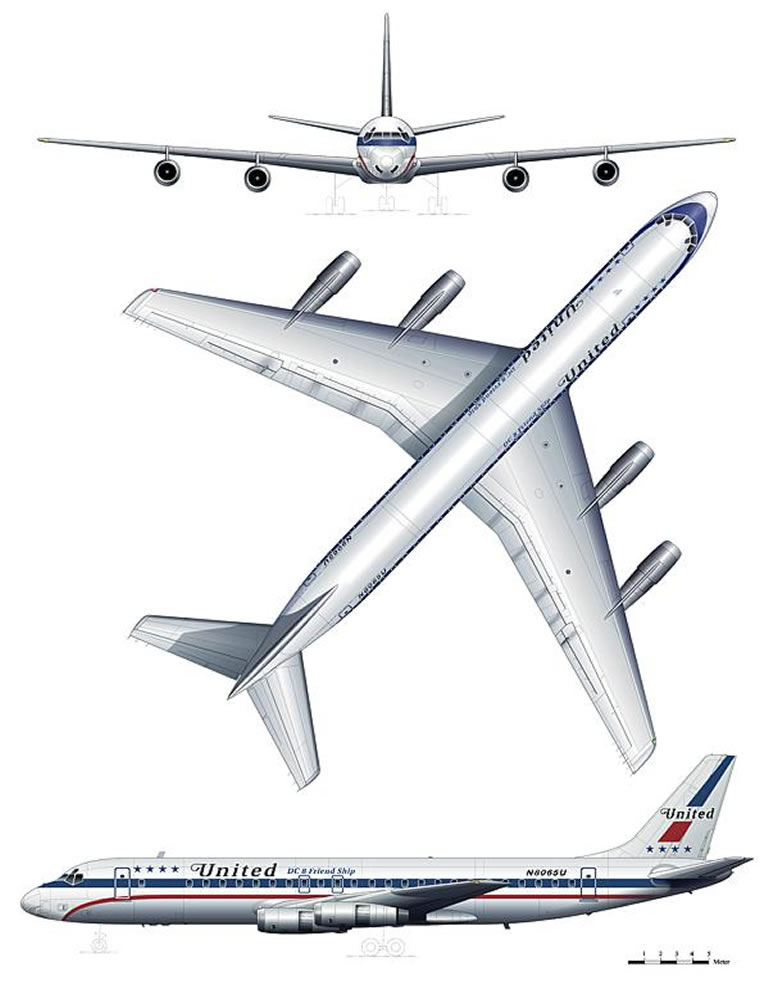
The DC-8 was officially announced in July 1955. Four versions were offered to begin with, all based on the same 150 ft 6 in (45.9 m) long airframe with a 141 ft 1 in (43 m) wingspan, but varying in engines and fuel capacity, and with maximum weights between 120 and 130 tons. The maiden flight was planned for December 1957, with entry into revenue service in 1959. Well aware that they were lagging behind Boeing, Douglas began a major push to market the product.
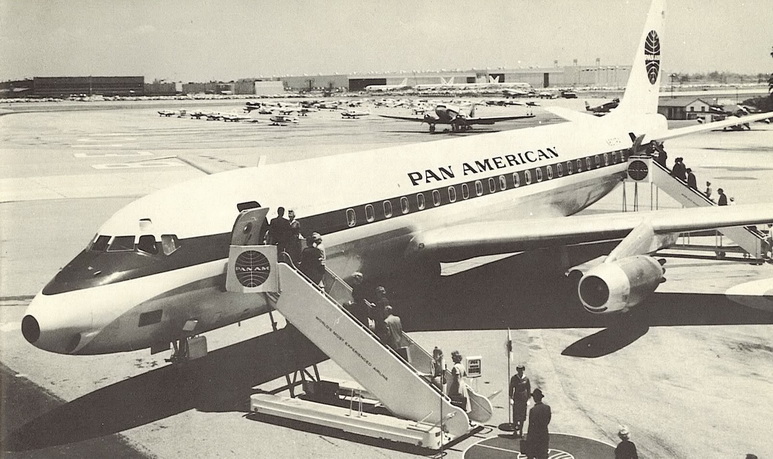
Worldwide, piston-engined airliners still ruled. The French 90-passenger twin jet Sud Aviation Caravelle prototype had just flown for the first time, the Comet was still grounded and the 707 was not expected to be available until late 1958. The transition, when it came, looked likely to be one to turboprops rather than turbojets. The pioneering 40–60-seat Vickers Viscount was already in service and proving enormously popular with both passengers and airlines: it was much faster, quieter and more comfortable than piston-engined types. Another British aircraft, the 90-seat Bristol Britannia, was establishing a fine reputation, and Douglas's main rival in the large, piston-engined passenger aircraft market, Lockheed, had committed to the short/medium range 80–100-seat turboprop Electra, with a launch order from American Airlines for 35 and other major orders flowing in. The major airlines were reluctant to commit themselves to the huge financial and technical challenge of jet aircraft. On the other hand, no-one could afford not to buy jets if their competitors did. And there the matter rested until October 1955, when the ever aggressive Pan American placed simultaneous orders with Boeing for 20 707s and Douglas for 25 DC-8s. To buy one expensive and untried jet-powered aircraft type was brave: to buy both was extraordinary.
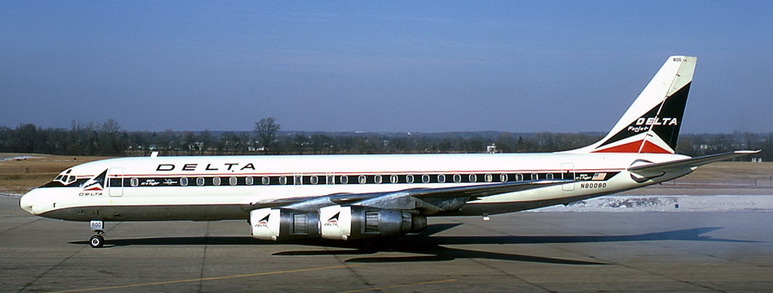
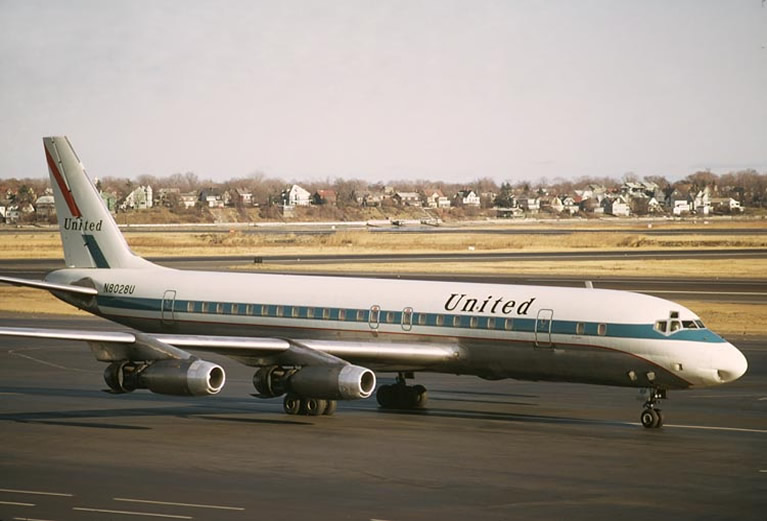
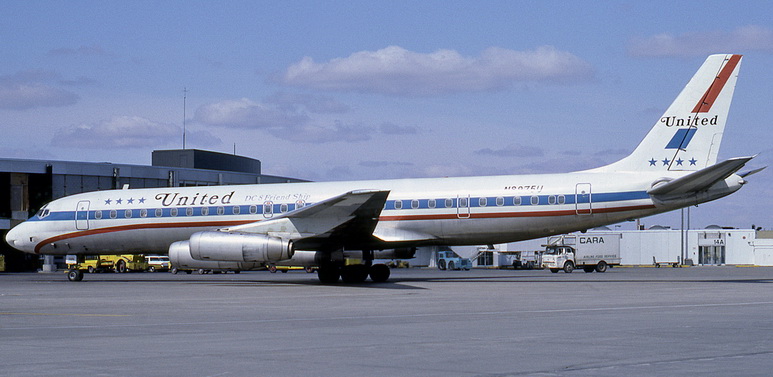
United Airlines chose the DC-8 over the Boeing 707.In the closing months of 1955, other airlines rushed to follow suit: Air France, American, Braniff, Continental and Sabena ordered 707s; United, National, KLM, Eastern, JAL and SAS chose the DC-8. In 1956 Air India, BOAC, Lufthansa, Qantas and TWA added over 50 to the 707 order book, while Douglas sold 22 DC-8s to Delta, Swissair, TAI, Trans-Canada and UAT. With KC-135 orders helping defray development costs, Boeing could offer lower prices, and also promise earlier delivery slots — though not as early as expected, because the DC-8 with its wider fuselage had constrained Boeing to take time out to redesign the KC-135 with a wider fuselage again, and the first production-ready 707 did not fly until December 1957.
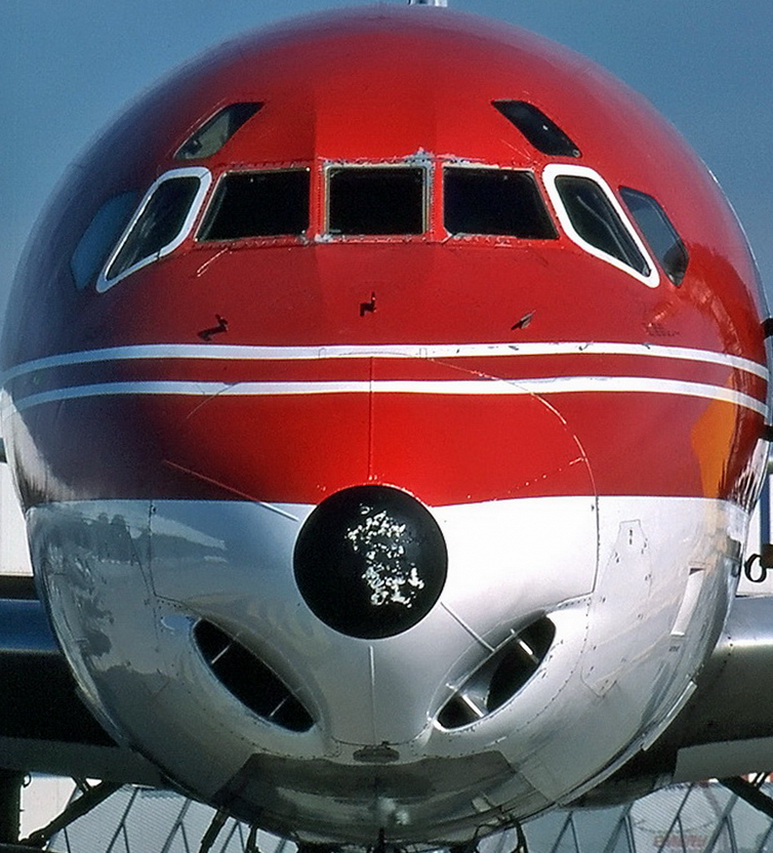
By the start of 1958 Douglas had sold 133 DC-8s as against Boeing's 150 707s. Nevertheless, the pattern from that time on would be for the DC-8 to sell in modest numbers, while Boeing sold roughly twice as many 707s. The first DC-8 was rolled out of the new factory at Long Beach in April 1958 and flew for the first time in May. Later that year an enlarged version of the Comet finally returned to service — but too late to take a substantial portion of the market: de Havilland had just 25 orders — and in October Boeing began delivering 707s to Pan Am.
Douglas made a massive effort to close the gap, using no less than ten individual aircraft for flight testing to achieve FAA certification for the first of the many DC-8 variants in August 1959. Much had needed to be done: the original air brakes on the lower rear fuselage were found ineffective and were simply deleted as engine thrust reversers had become available; unique leading-edge slots were added to improve low-speed lift; the prototype was 25 knots (46 km/h) short of its promised cruising speed and a new, slightly larger wingtip had to be developed to reduce drag.
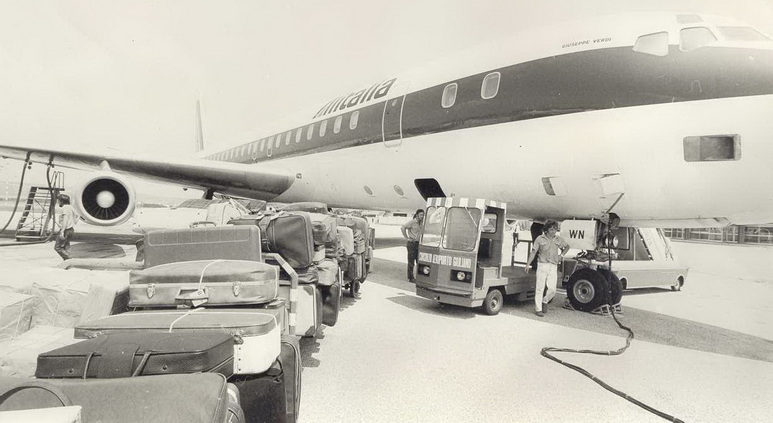
The DC-8 entered revenue service with both Delta Air Lines and United in September 1959. By March of 1960, Douglas had reached their planned production rate of eight DC-8s a month.
On August 21, 1961 a Douglas DC-8 broke the sound barrier at Mach 1.012 or 660 mph while in a controlled dive through 41,000 feet. The flight was to collect data on a new leading-edge design for the wing. The DC-8 became the first civilian jet to make a supersonic flight. The aircraft was a DC-8-43 later delivered to Canadian Pacific Air Lines as CF-CPG.
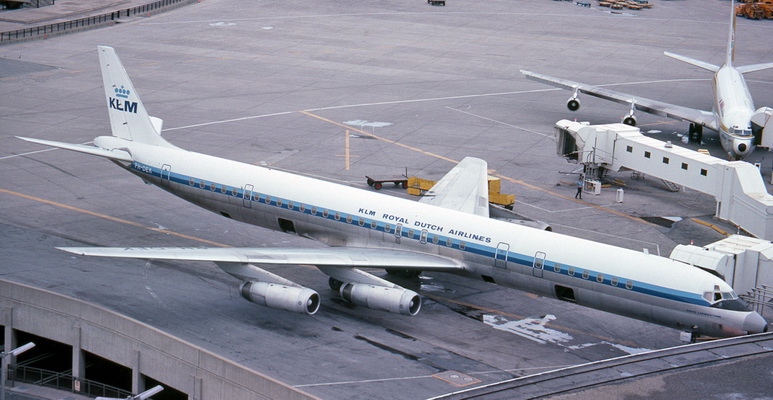
Despite the large number of DC-8 early models available, all used the same basic airframe, differing only in engines, weights and details. In contrast, Boeing's rival 707 range offered several fuselage lengths: the original 44 m 707-120, a 41 m version that sacrificed space to gain longer range, and the stretched 707-320, which at 46.5 m overall had 3 m more cabin space than the DC-8. Douglas steadfastly refused to create stretched or shortened versions of the DC-8, and gradually lost market share to Boeing. After an excellent start, 1962 DC-8 sales dropped to just 26, followed by 21 in 1963 and 14 in '64, and most of these were for the Jet Trader rather than the more prestigious passenger versions. Despite fair sales for the DC-8 and excellent results from the twin-jet DC-9 program, in 1967 Douglas were forced to merge with McDonnell Aircraft Corporation to become McDonnell Douglas (MDC).
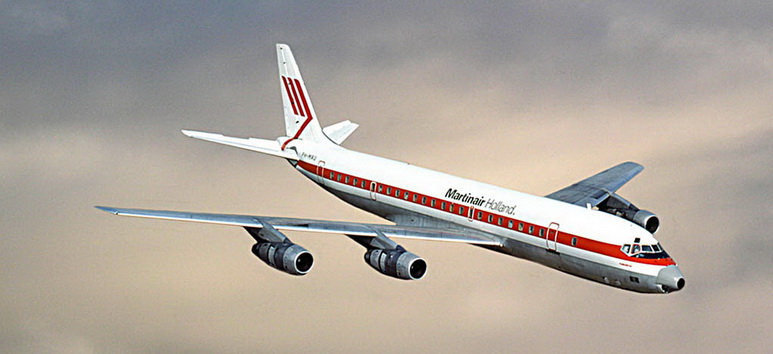
In April 1965, Douglas announced belated fuselage stretches for the DC-8, with not just one but three new models, known as the Super Sixties. The DC-8 program had been in danger of closing with fewer than 300 aircraft sold, but the Super Sixties brought fresh life to it. By the time production ceased in 1972, 262 of the stretched DC-8s had been made. With the ability to seat 269 passengers, the DC-8 was easily the largest airliner available, and remained so until the Boeing 747 arrived in 1970.
All the earlier jetliners were noisy by modern standards. Increasing traffic densities and changing public attitudes led to complaints about aircraft noise and moves to introduce restrictions. As early as 1966 the New York Port Authority expressed concern about the noise to be expected from the then still unbuilt DC-8-61, and operators had to agree to operate it from New York at lower weights to reduce noise. By the early 1970s, legislation for aircraft noise standards was being introduced in many countries, and the 60 Series DC-8s were particularly at risk of being banned from major airports.
In the early 1970s several airlines approached McDonnell Douglas for noise reduction modifications to the DC-8 but nothing was done. Third parties had developed aftermarket hushkits but there was no real move to keep the DC-8 in service. Finally, in 1975, General Electric began discussions with major airlines with a view to fitting the new and vastly quieter Franco-American CFM56 engine to both DC-8s and 707s. MDC remained reluctant but eventually came on board in the late 1970s and helped develop the 70 Series DC-8s.
The Super Seventies were a great success: roughly 70% quieter than the 60-Series and, at the time of their introduction, the world's quietest four-engined airliner. As well as being quieter and more powerful, the CFM56 was roughly 20% more fuel efficient than the JT3D, which reduced operating costs and extended the range.
Legacy
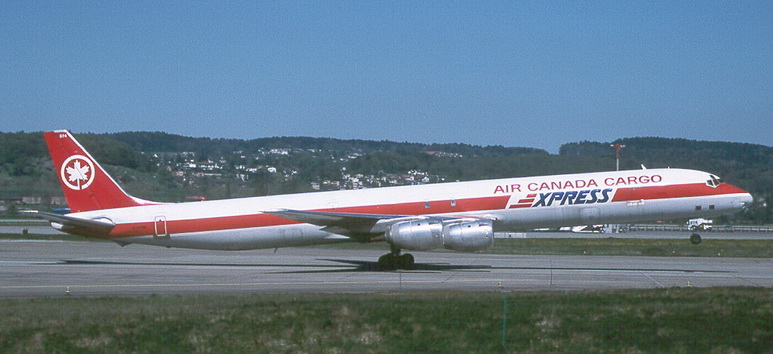
Throughout its production life the DC-8 was often regarded, unfairly, as little more than a copy of the 707, which outsold it by roughly two to one. But in the longer term the DC-8 proved its value. By 2002, of the 1032 707s and 720s manufactured for commercial use, just 80 remained in service — though many of those 707s wound up converted for USAF use, either in service or for spare parts. Of the 556 DC-8s made, around 200 were still in commercial service in 2002, including about 25 50-Series, 82 of the stretched 60-Series, and 96 out of the 110 re-engined 70-Series. Most of the surviving DC-8s are now used as freighters.
Variants
Early models
DC-8 Series 10 For U.S. domestic use and powered by 60.5 kN Pratt & Whitney JT3C-6 turbojets. The initial DC-8-11 model had the original, high-drag wingtips and all examples were subsequently converted to DC-8-12 standard. The DC-8-12 had the new wingtips and leading-edge slots inboard of each pylon. These unique devices were actuated by doors on the upper and lower surfaces that opened for low speed flight and closed for cruise. The maximum weight increased from 120 tonnes to 123 tonnes. 28 DC-8-10s were manufactured. This model was originally named "DC-8A" until the series 30 was introduced.
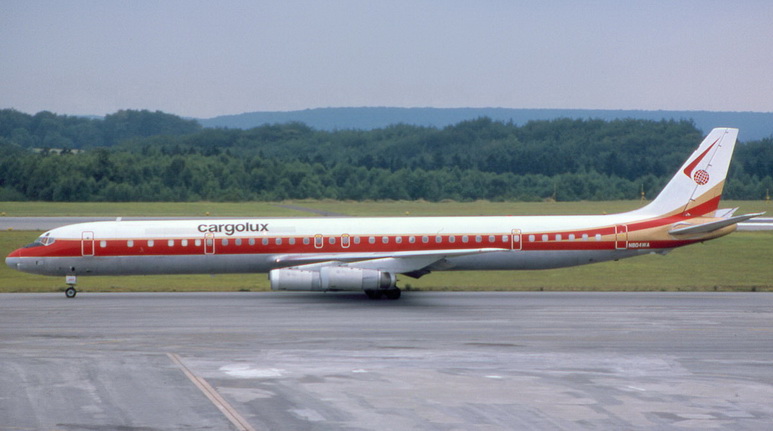
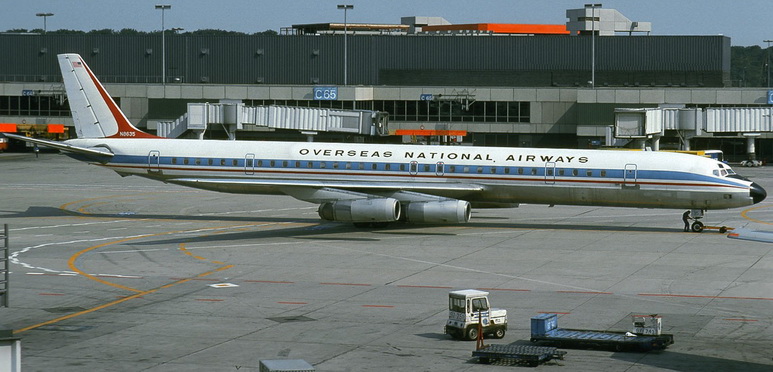
DC-8-32 of Overseas National Airways in Zurich, 1975DC-8 Series 20 Higher-powered 70.8 kN Pratt & Whitney JT4A-3 turbojets allowed a weight increase to 125 tonnes. 34 DC-8-20s were manufactured. This model was originally named "DC-8B" but was renamed when the series 30 was introduced.
DC-8 Series 30 For intercontinental routes, the three Series 30 variants combined JT4A engines with a one-third increase in fuel capacity and strengthened fuselage and landing gear. The DC-8-31 was certified in March 1960 with 75.2 kN JT4A-9 engines for 136 tonnes maximum weight. The DC-8-32 was similar but allowed 140 tonnes weight. The DC-8-33 of November 1960 substituted 78.4 kN JT4A-11 turbojets, a modification to the flap linkage to allow a 1.5 degree setting for more efficient cruise, stronger landing gear, and 143 tonne maximum weight. Many -31 and -32 DC-8s were upgraded to this standard. 57 DC-8-30s were produced.
DC-8 Series 40 The first turbofan-powered airliner in the world, the -40 was essentially the same as the -30 but with 78.4 kN Rolls-Royce Conway turbofans for better efficiency, less noise and less smoke. The Conway was a significant improvement over the turbojets that preceded it, but the Series 40 sold poorly both because of the traditional reluctance of U.S. airlines to buy a foreign product and because the still more advanced Pratt & Whitney JT3D turbofan was due in early 1961. The DC-8-41 and DC-8-42 had weights of 136 and 140 tonnes, the 143 tonne DC-8-43 had the 1.5 degree flap setting of the -33 and introduced a new 4% leading edge wing extension to allow a small fuel capacity increase and a significant drag reduction — the new wing design improved range by 8%, lifting capacity by 3 tonnes, and cruising speed by better than 10 knots (19 km/h). It would be included in all future DC-8s. 32 DC-8-40s were manufactured.
DC-8 Series 50 The definitive short-fuselage DC-8 with the same engine that powered the vast majority of 707s, the JT3D. Many earlier DC-8s were converted to this standard. All bar the -55 were certified in 1961. The DC-8-51, DC-8-52 and DC-8-53 all had 76.1 kN JT3D-1 or 80.6 kN JT3D-3B engines, varying mainly in their weights: 126, 138 and 142 tonnes respectively. The DC-8-53 arrived in June 1964, retaining the JT3D-3B engines but with strengthened structure from the freighter versions and 147 tonne maximum weight. 88 DC-8-50s were manufactured.
DC-8 Jet Trader Douglas approved development of specialized freighter versions of the DC-8 in May 1961, based on the Series 50. An original plan to fit a fixed bulkhead separating the forward two-thirds of the cabin for freight, leaving the rear cabin for 54 passenger seats was soon replaced by a more practical one to use a movable bulkhead and allow anywhere between 25 and 114 seats with the remainder set aside for cargo. A large cargo door was fitted into the forward fuselage, the cabin floor was reinforced and the rear pressure bulkhead was moved by nearly 2 m to make more space. Airlines were offered the option of a windowless cabin, though only one, United, took this up, with an order for 15 in 1964. The DC-8F-54 had a maximum takeoff weight of 143 tonnes and the DC-8F-55 147 tonnes. Both used 80.6 kN JT3D-3B powerplants.
Super sixties
The DC-8 Series 61 was designed for high capacity and medium range. It had the same weights and engines as the -53, and sacrificed range to gain capacity. Having decided to stretch the DC-8, Douglas inserted a 6 m plug in the forward fuselage and a 5 m plug aft, taking overall length to 57 m and giving the aircraft a very long, lean look that was (and is still) unique. Bending forces required strengthening of the structure, but the basic DC-8 design already had sufficient ground clearance to permit the one-third increase in cabin size without requiring longer landing gear. It was certificated in September 1966 and typically carried 210 passengers, or 269 in high-density configuration. 88 were sold.
The long-range DC-8 Series 62 followed in April 1967. It had a much more modest stretch of just 2 m (with 1 m plugs fore and aft), the same JT3D engines as the -53 and -61, and a number of modifications to provide greater range. One-meter wingtip extensions reduced drag and added fuel capacity, and Douglas redesigned the engine pods, extending the pylons and substituting new shorter and neater nacelles, all in the cause of drag reduction. Slightly heavier than the -53 or -61 at 151 tonnes, and able to seat 159 passengers, the -62 had a range with full payload of about 5200 nautical miles (9,600 km), or about the same as the -53 but with 40 extra passengers. 67 were built.
The DC-8 Series 63 was the final new build variant and entered service in June 1968. It combined the aerodynamic refinements and increased fuel capacity of the -62 with the very long fuselage of the -61, and added 85 kN JT3D-7 turbofans, giving a maximum take off weight of almost 159 tonnes and a range with full payload of 4,110 nautical miles (7,600 km). 107 were built, a little over half of them convertibles or dedicated freighters.
Super seventies
BAX Global DC-8-71(F) at Boeing FieldThe DC-8-72 and the DC-8-73 were straightforward conversions of the -62 and -63, replacing the JT3D engines with 98.5 kN CFM56-2 high-bypass turbofans in new housings built by Grumman. The DC-8-71 achieved the same end but required considerably more modification because the -61 did not already have the improved wings and relocated engines of the -62 and -63. Maximum takeoff weights remained the same but there was a slight reduction in payload because of the heavier engines. All three models were certified in 1982 and a total of 110 60-Series DC-8s were converted by the time the program ended in 1986.
Statistics
Production
Total production: 556 from 1960 to 1972
DC-8-10, 2
DC-8-20, 59
DC-8-30, 52
DC-8-40, 29
DC-8-50, 162
DC-8-60, 262
First flights
DC-8-10 May 30, 1958
DC-8-20 November 29, 1958
DC-8-30 February 21, 1959
DC-8-40 July 23, 1959
DC-8-50 December 20, 1960
DC-8-55 October 20, 1962
DC-8-61 March 14, 1966
DC-8-62 August 29, 1966
DC-8-63 April 10, 1967
(DC-8-61) DC-8-71 August 15, 1981
(DC-8-62) DC-8-72 December 5, 1981
(DC-8-63) DC-8-73 March 4, 1982 |