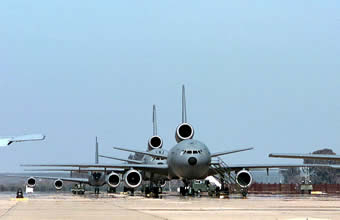
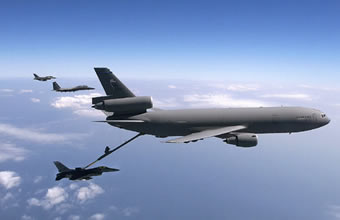
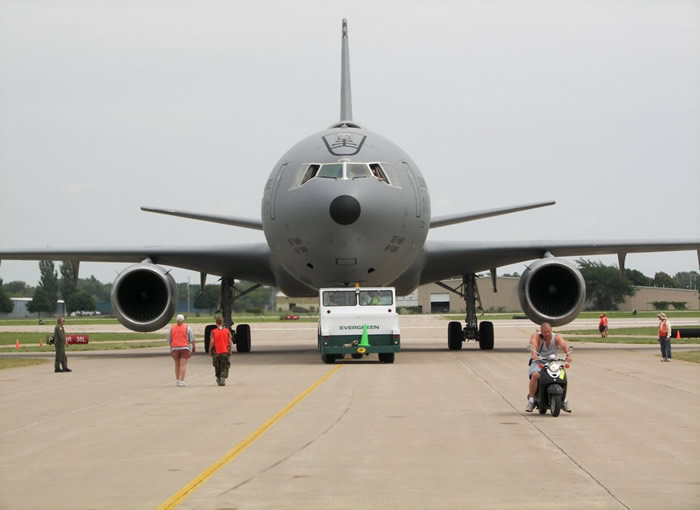
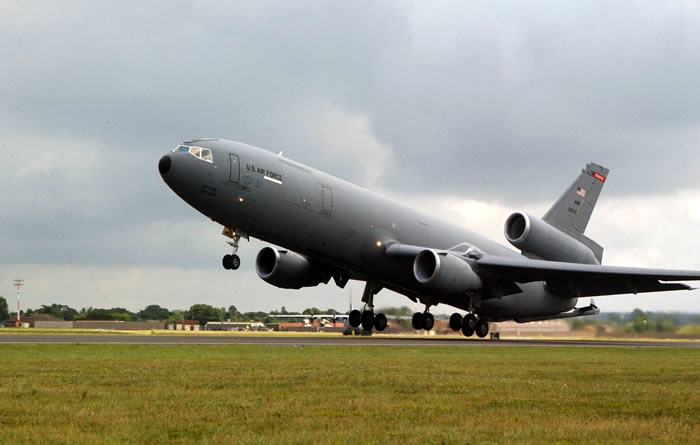
The KC-10 Extender is an Air Mobility Command advanced tanker and cargo aircraft designed to provide increased global mobility for U.S. armed forces.
Although the KC-l0's primary mission is aerial refueling, it can combine the tasks of a tanker and cargo aircraft by refueling fighters and simultaneously carry the fighter support personnel and equipment on overseas deployments.
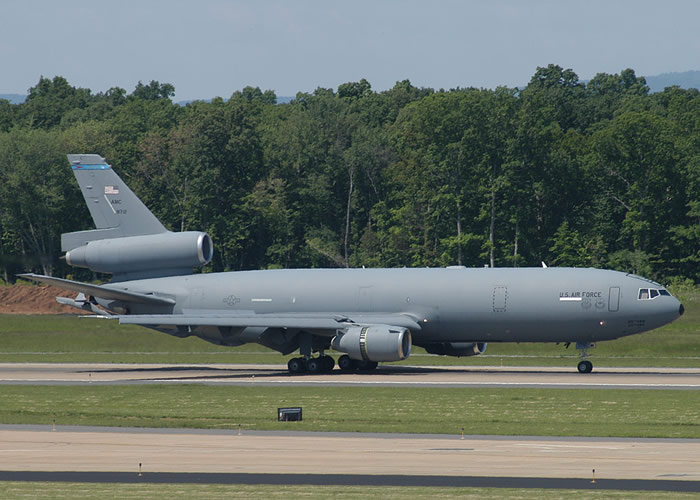
Features
The KC-10 can transport up to 75 people and nearly 170,000 pounds (76,560 kilograms) of cargo a distance of about 4,400 miles (7,040 kilometers) unrefueled.
In addition to the three main DC-10 wing fuel tanks, the KC-10 has three large fuel tanks under the cargo floor, one under the forward lower cargo compartment, one in the center wing area and one under the rear compartment. Combined, the capacity of the six tanks carry more than 356,000 pounds (160,200 kilograms) of fuel - almost twice as much as the KC-135 Stratotanker.
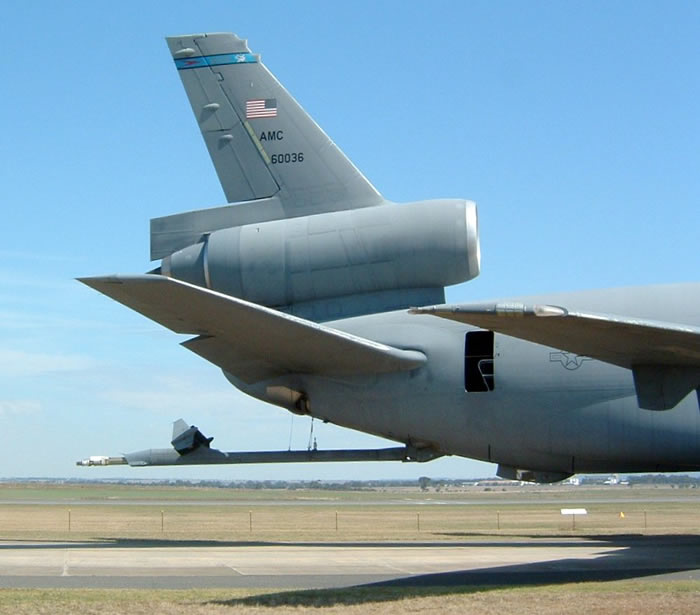
Using either an advanced aerial refueling boom, or a hose and drogue centerline refueling system, the KC-10 can refuel a wide variety of U.S. and allied military aircraft within the same mission. The aircraft is equipped with lighting for night operations.
The KC-10's boom operator controls refueling operations through a digital, fly-by wire system. Sitting in the rear of the aircraft, the operator can see the receiver aircraft through a wide window. During boom refueling operations, fuel is transferred to the receiver at a maximum rate of 1,100 gallons (4,180 liters) per minute; the hose and drogue refueling maximum rate is 470 gallons (1,786 liters) per minute. The Automatic Load Alleviation System and Independent Disconnect System greatly enhances safety and facilitates air refueling. The KC-10 can be air-refueled by a KC-135 or another KC-10A to increase its delivery range.
The large cargo-loading door can accept most air forces' fighter unit support equipment. Powered rollers and winches inside the cargo compartment permit moving heavy loads. The cargo compartment can accommodate loads ranging from 27 pallets to a mix of 17 pallets and 75 passengers.
Background
A modified Boeing Company DC-10, the KC-10A entered service in 1981. Although it retains 88 percent systems commonality with the DC-10, it has additional systems and equipment necessary for its Air Force mission. These additions include military avionics; aerial refueling boom and aerial refueling hose and drogue; seated aerial refueling operator station; and aerial refueling receptacle and satellite communications.
The KC-10 fleet was modified to add wing-mounted pods to further enhance aerial refueling capabilities. Ongoing modifications include the addition of communications, navigation and surveillance equipment to meet future civil air traffic control needs, and the incorporation of service bulletins to maintain Federal Aviation Administration certification.
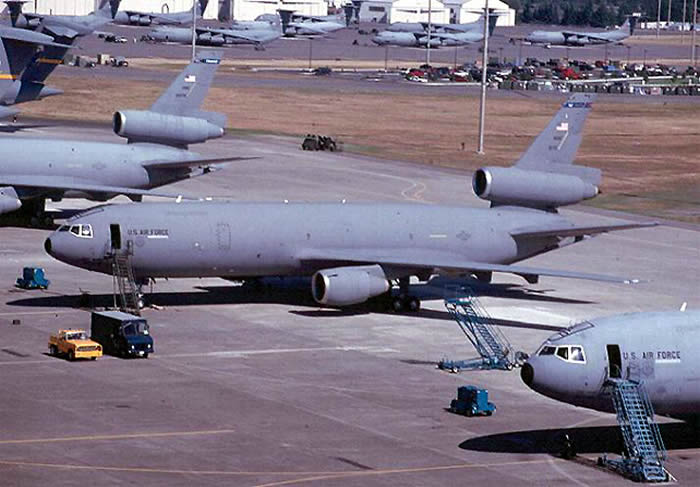
The KC-10A is operated by the 305th Air Mobility Wing, McGuire Air Force Base, N.J.; and the 60th Air Mobility Wing, Travis AFB, Calif. Air Force Reserve Associate units are assigned to the 349th Air Mobility Wing at Travis, and the 514th Air Mobility Wing at McGuire.
During operations Desert Shield and Desert Storm in 1991, the KC-10 fleet provided in-flight refueling to aircraft from the U.S. armed forces as well as those of other coalition forces. In the early stages of Operation Desert Shield, in-flight refueling was key to the rapid airlift of materiel and forces. In addition to refueling airlift aircraft, the KC-10, along with the smaller KC-135, moved thousands of tons of cargo and thousands of troops in support of the massive Persian Gulf buildup. The KC-10 and the KC-135 conducted about 51,700 separate refueling operations and delivered 125 million gallons (475 million liters) of fuel without missing a single scheduled rendezvous.
The NATO air campaign against Yugoslavia began March 24, 1999, following the breakdown of negotiations between the members of NATO and the government of Yugoslavia over the Yugoslav oppression of the ethnic Albanian majority residing in the Serbian region of Kosovo. The campaign dubbed Allied Force culminated months of preparation. The mobility portion of the operation began in February and was tanker dependent. By early May 1999, some 150 KC-10s and KC-135s deployed to Europe where they refueled bombers, fighters and support aircraft engaged in the conflict. The KC-10 flew 409 missions throughout the entire Allied Force campaign and continued support operations in Kosovo.
General Characteristics
Primary Function: Aerial tanker and transport
Prime Contractor: The Boeing Company
Power Plant: Three General Electric CF6-50C2 turbofans
Thrust: 52,500 pounds (23,625 kilograms), each engine
Length: 181 feet, 7 inches (54.4 meters)
Height: 58 feet, 1 inch (17.4 meters)
Wingspan: 165 feet, 4.5 inches (50 meters)
Speed: 619 mph (Mach 0.825)
Ceiling: 42,000 feet (12,727 meters)
Maximum Takeoff Weight: 590,000 pounds (265,500 kilograms)
Range: 4,400 miles (3,800 nautical miles) with cargo; 11,500 miles (10,000 nautical miles) without cargo
Maximum Cargo Payload: 170,000 pounds (76,560 kilograms)
Pallet Positions: 27
Maximum Fuel Load: 356,000 pounds (160,200 kilograms)
Crew: Four (pilot, co-pilot, flight engineer and boom operator) Certain missions may require additional crew members.
Unit Cost: $88.4 million (FY 98 constant dollars)
Date Deployed: March 1981
Inventory: Active force, 59; ANG, 0; Reserve, 0 |