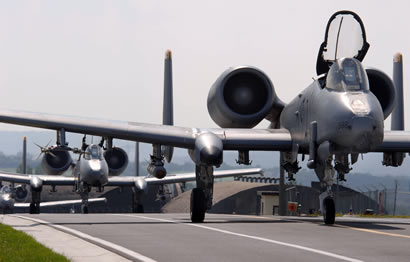
The A-10 Thunderbolt II is the first Air Force aircraft specially designed for close air support of ground forces.
They are simple, effective and survivable twin-engine jet aircraft that can be used against all ground targets, including tanks and other armored vehicles.
Features
The A-10/OA-10 have excellent maneuverability at low air speeds and altitude, and are highly accurate weapons-delivery platforms. They can loiter near battle areas for extended periods of time and operate under 1,000-foot ceilings (303.3 meters) with 1.5-mile (2.4 kilometers) visibility. Their wide combat radius and short takeoff and landing capability permit operations in and out of locations near front lines. Using night vision goggles, A-10/ OA-10 pilots can conduct their missions during darkness.
Thunderbolt IIs have Night Vision Imaging Systems (NVIS), goggle compatible single-seat cockpits forward of their wings and a large bubble canopy which provides pilots all-around vision. The pilots are protected by titanium armor that also protects parts of the flight-control system. The redundant primary structural sections allow the aircraft to enjoy better survivability during close air support than did previous aircraft.
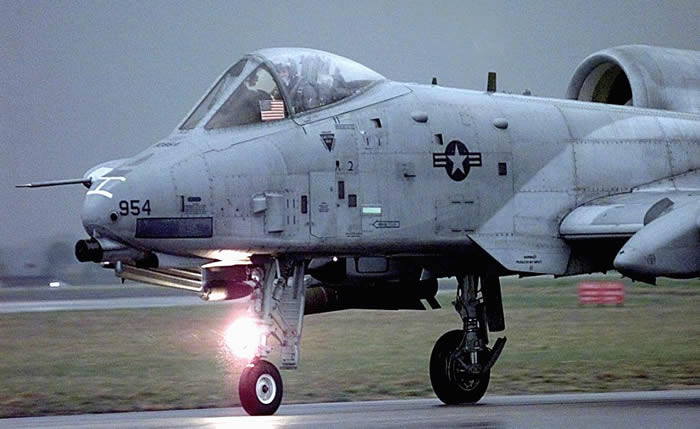
The aircraft can survive direct hits from armor-piercing and high explosive projectiles up to 23mm. Their self-sealing fuel cells are protected by internal and external foam. Manual systems back up their redundant hydraulic flight-control systems. This permits pilots to fly and land when hydraulic power is lost.
The Thunderbolt II can be serviced and operated from bases with limited facilities near battle areas. Many of the aircraft's parts are interchangeable left and right, including the engines, main landing gear and vertical stabilizers.

Avionics equipment includes communications, inertial navigation systems, fire control and weapons delivery systems, target penetration aids and night vision goggles. Their weapons delivery systems include heads-up displays that indicate airspeed, altitude, dive angle, navigation information and weapons aiming references; a low altitude safety and targeting enhancement system (LASTE) which provides constantly computing impact point freefall ordnance delivery; and Pave Penny laser-tracking pods under the fuselage. The aircraft also have armament control panels, and infrared and electronic countermeasures to handle surface-to-air-missile threats. Installation of the Global Positioning System is currently underway for all aircraft.
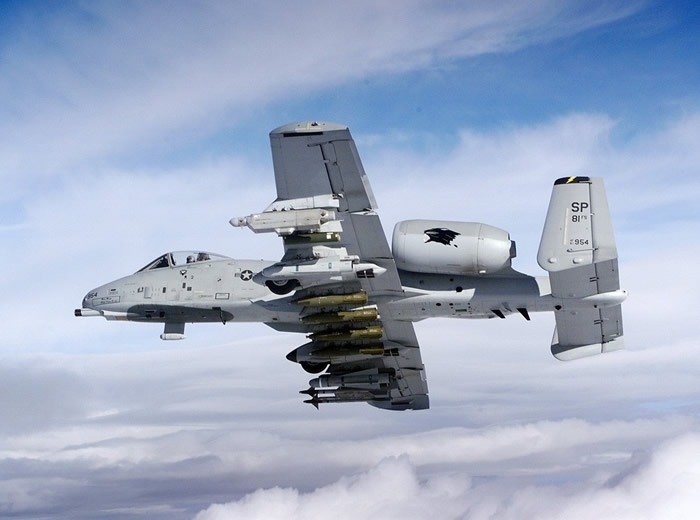
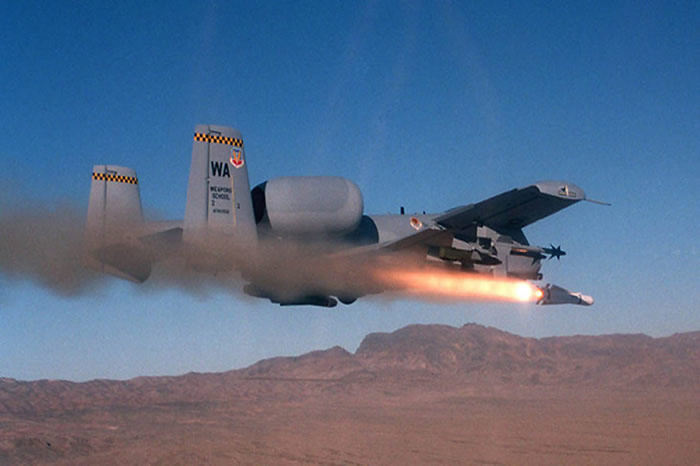
The Thunderbolt II's 30mm GAU-8/A Gatling gun can fire 3,900 rounds a minute and can defeat an array of ground targets to include tanks. Some of their other equipment includes an inertial navigation system, electronic countermeasures, target penetration aids, self-protection systems, and AGM-65 Maverick and AIM-9 Sidewinder missiles.
Background
The first production A-10A was delivered to Davis-Monthan Air Force Base, Ariz., in October 1975. It was designed specially for the close air support mission and had the ability to combine large military loads, long loiter and wide combat radius, which proved to be vital assets to the United States and its allies during Operation Desert Storm and Operation Noble Anvil.
In the Gulf War, A-10s had a mission capable rate of 95.7 percent, flew 8,100 sorties and launched 90 percent of the AGM-65 Maverick missiles.
General Characteristics
Primary Function: A-10 -- close air support, OA-10 - airborne forward air control
Contractor: Fairchild Republic Co.
Power Plant: Two General Electric TF34-GE-100 turbofans
Thrust: 9,065 pounds each engine
Length: 53 feet, 4 inches (16.16 meters)
Height: 14 feet, 8 inches (4.42 meters)
Wingspan: 57 feet, 6 inches (17.42 meters)
Speed: 420 miles per hour (Mach 0.56)
Ceiling: 45,000 feet (13,636 meters)
Maximum Takeoff Weight: 51,000 pounds (22,950 kilograms)
Range: 800 miles (695 nautical miles)
Armament: One 30 mm GAU-8/A seven-barrel Gatling gun; up to 16,000 pounds (7,200 kilograms) of mixed ordnance on eight under-wing and three under-fuselage pylon stations, including 500 pound (225 kilograms) Mk-82 and 2,000 pounds (900 kilograms) Mk-84 series low/high drag bombs, incendiary cluster bombs, combined effects munitions, mine dispensing munitions, AGM-65 Maverick missiles and laser-guided/electro-optically guided bombs; infrared countermeasure flares; electronic countermeasure chaff; jammer pods; 2.75-inch (6.99 centimeters) rockets; illumination flares and AIM-9 Sidewinder missiles.
Crew: One
Date Deployed: March 1976
Unit Cost: $9.8 million (fiscal 98 constant dollars)
Inventory: Active force, A-10, 143 and OA-10, 70; Reserve, A-10, 46 and OA-10, 6; ANG, A-10, 84 and OA-10, 18 |